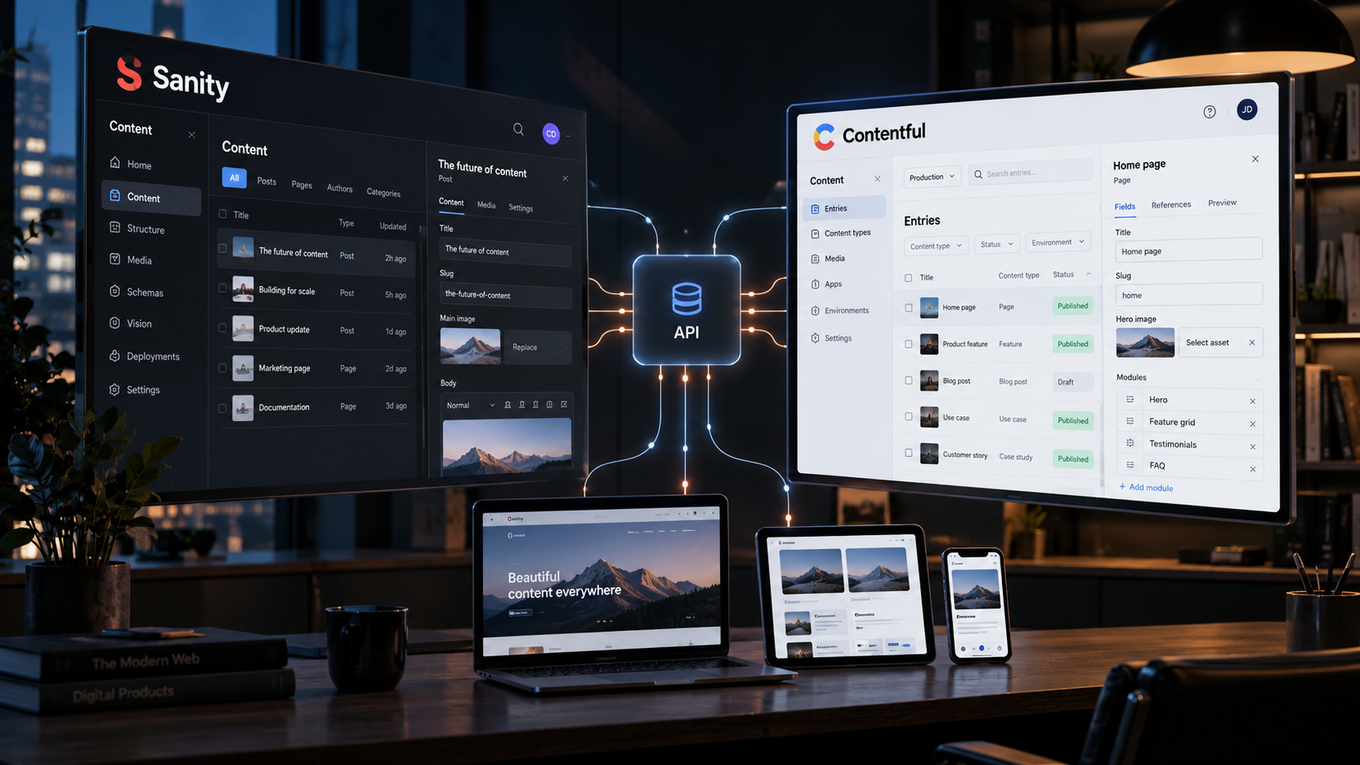
Sanity and Contentful are two established headless CMS platforms that help businesses manage structured content across websites, apps and digital channels. Both offer flexible content models, APIs and tools for managing content at scale.
The main difference is how each platform approaches content modelling and the editing experience. Sanity offers extensive control through its code configured Sanity Studio, while Contentful provides a managed content platform with configurable content types, editorial tools and extensibility through apps.
Neither is automatically the better choice. The right platform depends on your content requirements, publishing workflows, integrations, governance and development resources.
At Flight Digital, we look beyond the CMS itself. The technology needs to work for your content team, the customer experience and whatever comes next.
Sanity vs Contentful at a glance
Both platforms take a headless approach, separating content management from the website or application that displays it.
However, they differ in how teams configure content, manage workflows and maintain their digital platforms.
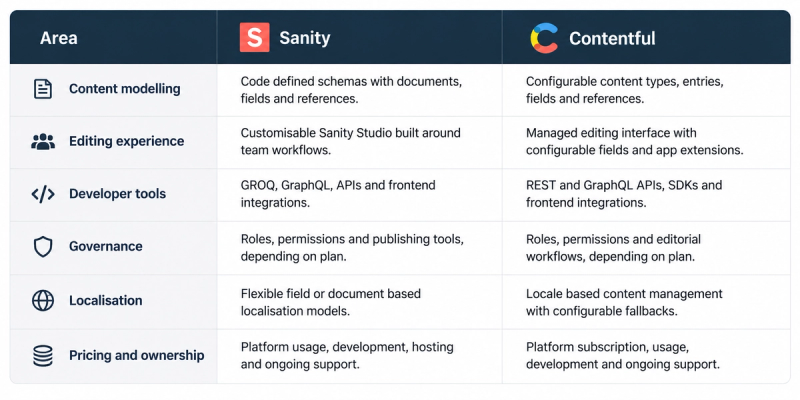
Neither platform guarantees better performance, lower costs or stronger SEO. Those outcomes depend on how the website and wider technology stack are designed and maintained.
What are Sanity and Contentful?
Sanity and Contentful both manage content independently from its presentation. This allows businesses to deliver information to different digital experiences without tying everything to one website template.
The main differences become clearer when you look at how each platform works.
What is Sanity CMS?
Sanity is a headless CMS and structured content platform designed around flexible content modelling.
It uses three core components:
- Content Lake: A hosted content backend that stores structured information.
- Sanity Studio: A customisable editing environment for creating, managing and publishing content.
- Content APIs: Tools for retrieving and updating information across websites, applications and other systems.
Developers define content types, fields, relationships and validation rules through schemas.
For example, a business could create separate content types for services, locations, team members, articles and case studies, then connect them through references.
Instead of duplicating the same information across pages, the content can be managed centrally and reused where needed.
Sanity Studio is particularly flexible because developers can customise the editing interface around how an organisation works.
At Flight, our Sanity CMS development services the connect content modelling, editorial workflows, frontend development and integrations to create platforms that are useful for both customers and content teams.
Sanity Studio is open source, while its Content Lake and associated content services are hosted by Sanity. This distinction matters when considering infrastructure ownership.
What is Contentful CMS?
Contentful is a managed headless content platform that helps organisations structure, manage and distribute content through APIs.
Its content model is built around content types, entries, fields and references.
For example, a business might create a product content type with fields for the product name, description, images and related categories.
Editors then create entries using that structure.
Contentful organises content within spaces and environments, allowing teams to manage content and development changes within defined areas.
It also provides REST and GraphQL APIs, along with tools for managing editorial access, publishing and localisation.
Contentful's managed editing interface can be configured through content models, field settings and extensions.
This can suit organisations that want a structured content platform with established editorial tools while still allowing developers to extend the experience.
What are the key differences between Sanity and Contentful?
Both platforms can support complex digital experiences. The differences are less about whether something is technically possible and more about how it is implemented, managed and maintained.
1. Content modelling and reuse
A good content model is the foundation of a useful headless CMS.
It determines how information is organised, how content connects and how easily teams can reuse it.
Sanity uses code defined schemas to create content types, fields and relationships.
This gives developers detailed control over how content is structured and validated.
Contentful uses content types and fields that can be configured through its interface or management APIs.
Both platforms support reusable content and references between entries.
Consider a business operating across Auckland, Wellington and Christchurch.
It might need separate information for each location, including its address, opening hours, services and team members.
With either platform, these details can be modelled as structured content rather than copied into every location page.
The difference becomes important when requirements change.
Sanity's code based approach can suit developer led teams that want detailed control over schemas and their configuration.
Contentful's interface based content modelling can make certain changes more accessible to authorised content administrators, although complex changes still require planning and development.
What matters most is whether your content model can evolve without making everyday publishing harder.
A well designed model should help teams maintain consistent information while allowing content to be adapted to different customer needs.
2. Editing experience and collaboration
The editing experience is where the CMS decision becomes real for your content team.
Sanity Studio can be customised around an organisation's content structure and publishing workflows.
Developers can create custom input components, organise editing views and build tools that connect with other systems.
For a marketing team, this might mean a workspace organised around campaigns, landing pages, customer stories and shared resources.
Contentful offers a managed editing interface with configurable fields, content views and app extensions.
Its editorial tools can support structured publishing processes, including tasks, workflows and content reviews, depending on configuration and plan.
Both platforms can support previews and collaborative content operations.
The difference is how much customisation your organisation requires and how much development effort that customisation involves.
Before choosing, ask your editors to complete a few real tasks:
- Create a new landing page.
- Update information reused across several pages.
- Preview an unpublished change.
- Request approval from another team member.
- Publish several related updates.
A platform may look impressive during a demonstration, but usability depends on how well it handles these everyday tasks.
At Flight, we believe the content editing experience should be designed with the same care as the customer facing website.
After all, the platform needs to work for the people maintaining it long after launch.
3. Developer tools and integrations
Both Sanity and Contentful provide APIs for connecting content with websites and other digital services.
Sanity supports GROQ, its content query language, along with GraphQL and APIs for working with structured content.
GROQ allows developers to retrieve and shape the information needed by a particular frontend component.
Contentful provides REST and GraphQL APIs, SDKs and developer tools for accessing and managing content.
Both platforms can be integrated with frontend frameworks such as Next.js.
For businesses, the practical question is how the CMS connects with their wider technology ecosystem.
That might include:
- Ecommerce platforms.
- Customer relationship management systems.
- Marketing automation tools.
- Product information management.
- Search services.
- Analytics and reporting platforms.
Imagine an ecommerce business that manages product pricing and inventory in Shopify but wants more control over product storytelling.
The commerce platform could manage transactional information, while the headless CMS manages editorial content, buying guides and campaign experiences.
The frontend then brings those systems together.
Both Sanity and Contentful can support this type of architecture.
The decision depends on integration requirements, the development team's expertise and how content needs to move between systems.
Our approach to website development (https://flightdigital.co.nz/capabilities/website-development-company) considers these connections from the beginning, rather than treating integrations as an afterthought.
A CMS should make your wider digital ecosystem easier to manage, not create another isolated system.
4. Governance, permissions and publishing
For larger organisations, choosing a CMS involves more than editing content.
You also need to decide who can create, review, approve and publish information.
Sanity provides roles and permissions, with more advanced access controls and coordinated publishing functionality available on particular plans.
Contentful also provides role based permissions and tools for editorial workflows.
For example, a business might require:
- A content editor to prepare a new page.
- A regional manager to review the information.
- A compliance team to approve specific claims.
- An authorised publisher to release the content.
Both platforms can support governance requirements, but the implementation approach and available features differ.
Contentful provides configurable workflows and related editorial tools.
Sanity offers flexible Studio configuration and publishing capabilities, including Content Releases for coordinating updates across documents on eligible plans.
Before selecting a platform, document the approval process your organisation needs.
Consider whether permissions should vary by team, region, content type or environment.
Security requirements, access controls, auditability and support arrangements should also be reviewed.
Not every feature is included in every subscription, so governance requirements should be matched against the current plan details before a decision is made.
5. Localisation and multiple markets
Managing content across different languages and markets introduces another layer of complexity.
Localisation is not simply translating a webpage.
Different markets may require unique product information, regional terminology, legal content, campaign messaging or publishing responsibilities.
Sanity supports different localisation approaches, including translated fields within a document or separate documents for each language.
This flexibility allows developers to design a model around how content is shared and managed.
Contentful provides locale based content management, allowing fields to contain translated values and supporting fallback behaviour where configured.
Both approaches can support multilingual websites and regional experiences.
For example, a New Zealand business expanding into Australia and the United Kingdom might want consistent brand content but different service information, terminology and promotional campaigns.
The CMS should make it clear which information is shared globally and which content can be managed locally.
Teams should also consider who owns translations, how updates are coordinated and how market specific changes are approved.
The best localisation model is the one that allows local teams to operate effectively without creating unnecessary content duplication or governance problems.
6. Pricing and total cost of ownership
Which platform is more cost effective, Sanity or Contentful?
There isn't a universal answer.
Both offer different subscription plans and usage allowances. The cost of implementation depends on the complexity of the website, content model, integrations and editorial requirements.
Sanity offers free, Growth and Enterprise plans, with differences in users, permissions, usage allowances and available features.
Contentful also offers free and paid options, with limits and capabilities that vary by plan.
Before comparing subscriptions, look at the total cost of ownership.
That includes:
- Platform costs: Subscription fees, users, API usage and storage.
- Implementation: Content modelling, frontend development and CMS configuration.
- Integrations: Connections with ecommerce, CRM, analytics and other systems.
- Migration: Moving existing content, media and functionality.
- Maintenance: Updates, testing, improvements and technical support.
- Governance: Additional requirements for permissions, environments and publishing workflows.
Sanity's customised Studio can create a tailored editorial experience, but building and maintaining that configuration requires development resources.
Contentful's managed tools may reduce some configuration work, although advanced requirements, extensions and commercial features can add costs.
Review the current Sanity pricing (https://www.sanity.io/pricing) and Contentful pricing (https://www.contentful.com/pricing/) against your expected usage before committing.
The cheapest subscription isn't necessarily the most affordable platform to operate over several years.
What does the CMS choice mean for SEO and AI search?
Sanity and Contentful can both support strong SEO and modern search experiences.
But neither platform automatically improves rankings or guarantees visibility in AI generated answers.
Search performance depends on how the website is built, how content is organised and whether search engines can access and understand important information.
For either CMS, essential SEO requirements include:
- Crawlable and indexable page content.
- Appropriate server rendering or pre-rendering.
- Editable page titles and meta descriptions.
- Canonical URLs and indexation controls.
- XML sitemaps and redirect management.
- Clear headings and contextual internal links.
- Relevant structured data.
- Fast, accessible website experiences.
An important distinction is that structured content in a CMS is not the same as structured data markup.
A CMS content schema defines how information is stored. Schema.org markup helps describe visible webpage content to search systems.
A well designed content model can make it easier to generate consistent structured data across relevant pages, but this still requires proper implementation.
The same principle applies to AI search.
Clear content relationships, accurate information and accessible pages can support content discovery and understanding.
However, selecting Sanity or Contentful does not guarantee AI citations, mentions or recommendations.
Flight's SEO and AI search approach connects content structure, technical accessibility, search intent and digital performance.
If your organisation is exploring how search is evolving, our article on SEO vs GEO explains the relationship between traditional search optimisation and visibility within AI generated answers.
The goal is to create content and technical foundations that work for people, search engines and emerging discovery experiences.
What should you consider before migrating to Sanity or Contentful?
A CMS migration is an opportunity to improve your content architecture, but it also introduces technical and operational risks.
Moving from an existing platform involves more than transferring articles and images.
Your organisation needs to preserve important functionality, content relationships and search visibility while preparing the new platform.
A practical migration process should include:
- Audit the existing website. Identify pages, content types, media, integrations and functionality.
- Map the new content model. Define how existing information will become structured and reusable.
- Plan URLs and redirects. Preserve valuable URLs where possible and map changed URLs directly to their new destinations.
- Migrate SEO elements. Transfer metadata, canonicals, structured data and relevant internal links.
- Reconnect integrations. Test forms, ecommerce, search, analytics and other connected systems.
- Test editorial workflows. Make sure editors can create, preview, review and publish content confidently.
- Monitor after launch. Check crawl errors, indexation, rankings, organic traffic and conversions.
A migration cannot guarantee that organic rankings or website performance will remain unchanged.
However, careful planning can reduce avoidable issues and make problems easier to identify.
For businesses considering a migration to Sanity, Flight connects content planning, technical implementation, SEO and launch testing.
The goal is not simply to replace the CMS. It's to build a stronger foundation for how your organisation manages content and delivers digital experiences.
How Flight approaches headless CMS selection
At Flight, we don't believe CMS selection should begin with a platform demonstration.
It should begin with understanding what the organisation needs to achieve.
We assess the CMS as one part of a wider digital platform, connecting content, customer experience, technology and long-term commercial requirements.
Our approach considers six areas.
1. Define the business requirements
We identify the platform's purpose, customer needs, existing limitations and future growth plans.
2. Map content and editorial workflows
We examine content types, relationships, publishing responsibilities and the tasks editors need to complete.
3. Review architecture and integrations
We consider the frontend, business systems, security, permissions and technical dependencies.
4. Test representative publishing tasks
Where appropriate, we validate how the proposed content model and editing experience will work for the team.
5. Compare implementation and operating costs
We assess subscriptions, development, integrations, hosting, maintenance and ongoing support.
6. Plan migration, launch and measurement
We account for content migration, SEO requirements, testing and the performance measures that matter after launch.
What this looks like in practice: Allpress Espresso
Our work with Allpress Espresso shows why a headless CMS decision needs to consider more than content editing.
Allpress operates across international markets, each with different ecommerce requirements, inventory structures and local customer needs.
Its previous platform setup created complexity across content management, commerce and product systems.
Flight replatformed Allpress onto a Sanity powered headless CMS integrated with Shopify.
The solution was designed to support multiple ecommerce markets while balancing central brand governance with local control.
Regional teams can manage market specific information, including storefront content and communications, within a more connected architecture.
The new approach also reduced platform complexity and ongoing operational costs for Allpress.
The important lesson isn't that every organisation should use the same technology.
It's that CMS selection should support the wider digital ecosystem.
For Allpress, connecting content management with ecommerce requirements helped create a platform designed for expansion without repeated structural rebuilds.
You can explore the architecture and outcomes in Allpress Espresso's headless replatforming case study.
Where does Strapi fit into the comparison?
Sanity and Contentful aren't the only options worth considering.
Strapi is another headless CMS that gives development teams control over content models, APIs and application deployment.
One important difference is hosting flexibility.
Strapi can be deployed on infrastructure managed by your organisation or through Strapi Cloud.
That can appeal to teams with specific infrastructure requirements, internal hosting expertise or a preference for managing their application environment.
However, self-hosting also introduces responsibilities around infrastructure, security, maintenance and deployment.
Strapi Cloud offers a managed hosting option that reduces some of those responsibilities.
The decision comes down to the balance between technical ownership and operational convenience.
For organisations comparing a wider range of CMS architectures, our Sanity vs Silverstripe comparison also explores how headless and more integrated development approaches differ.
Choosing the right headless CMS for your business
Sanity and Contentful are both capable platforms. The better choice depends on what your organisation needs the technology to do.
Sanity may be a strong fit when you want extensive control over the editing experience, structured content relationships and a frontend built around specific requirements.
Contentful may suit teams that value its managed editorial environment, configurable content models and established platform tooling.
Neither choice removes the need for thoughtful implementation.
Before committing, make sure you can answer these questions:
- How complex is our content structure?
- What does our editorial team need from the CMS?
- What development resources do we have?
- Which permissions and approvals are essential?
- What integrations must the platform support?
- How many markets, languages and channels do we manage?
- What will the platform cost to operate and maintain?
- What content, functionality and SEO value must we preserve during migration?
If those questions aren't clear yet, that's where the platform conversation should begin.
Choose a CMS your team can grow with
A good CMS should make content easier to manage, customer experiences easier to improve and future changes less difficult to deliver.
At Flight Digital, we bring strategy, UX, content modelling, development and SEO together to help organisations make informed technology decisions.
As an official Sanity Agency Partner, we've built platforms that connect structured content with ecommerce, publishing and custom digital experiences.
But the goal isn't simply to recommend Sanity.
It's to find the architecture that works for your organisation, your people and your plans for growth.
Whether you're comparing headless CMS platforms, planning a migration or looking to improve an existing website, talk to our team at Flight Digital about the right next step.