
GEO (generative engine optimisation) and AEO (answer engine optimisation) both aim to improve how businesses appear in answer-based search experiences.
AEO focuses on making content useful for direct answers, while GEO places greater emphasis on how brands and information appear within AI-generated responses, including mentions and citations.
The distinction isn't always clear-cut. Both approaches rely on strong SEO foundations, useful content and technically accessible websites.
At Flight Digital, we see GEO and AEO as connected parts of a wider search strategy, not competing disciplines.
The real question for businesses isn't which acronym to follow. It's how to make your information easier to find, understand and trust, then measure whether that visibility produces meaningful results.
GEO vs AEO: What is the difference?
The main difference between GEO and AEO is where each approach places its emphasis.
Answer engine optimisation focuses on helping content provide clear, accurate answers to specific questions. Generative engine optimisation focuses on improving how information and brands are represented within AI-generated responses.
Here's how they compare.
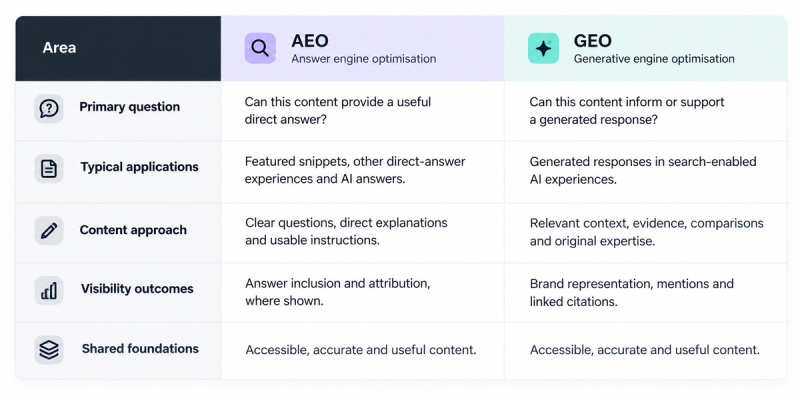
These distinctions describe areas of emphasis, not strict boundaries.
A page written to answer a customer question can also provide supporting information for an AI-generated response.
Similarly, well-researched content developed with GEO in mind may appear in traditional search results and direct-answer features.
The strongest approach combines clear answers with the context, evidence and expertise needed to make those answers useful.
What is answer engine optimisation (AEO)?
Answer engine optimisation is the practice of improving content so answer-based search systems can discover, understand and present useful responses to people's questions.
Traditional search often involves entering a query, reviewing several results and visiting a website to find information.
Answer-based experiences may provide some of that information directly.
For example, someone searching for "What is a headless CMS?" may encounter a featured snippet that explains the concept without needing to compare several articles first.
AEO aims to make information clear enough to serve these types of requests.
How does AEO work?
AEO starts by understanding the question behind a search.
Instead of simply adding keywords throughout a page, businesses should explain the topic in a way that helps someone reach an answer.
Useful content formats include:
- Direct definitions that explain a concept in plain language.
- Step-by-step instructions for completing a task.
- Comparison tables that clarify differences.
- Descriptive headings that organise related information.
- Concise explanations supported by relevant detail.
For example, an accounting business could answer "What does a fractional CFO do?" with a short definition followed by sections explaining responsibilities, costs and when a company might need the service.
The initial explanation addresses the immediate question. The supporting content helps someone exploring the topic in greater depth.
That structure is useful for readers regardless of whether a search engine chooses to feature the answer.
Does AEO only apply to featured snippets?
No. Although featured snippets are a familiar example, AEO is also used to describe optimisation for AI-powered answers, conversational search and other systems that respond directly to questions.
The terminology has expanded as search experiences have changed.
It's also important to understand that clear formatting doesn't guarantee featured snippet placement.
Google determines which pages appear in featured snippets through its own systems. Publishers cannot mark a page as a featured snippet or trigger the feature by adding structured data.
The goal should be to provide the best answer for the reader, not manipulate a particular search feature.
What is generative engine optimisation (GEO)?
Generative engine optimisation focuses on improving how content, brands and information appear within AI-generated responses.
AI search experiences such as Google AI Overviews, AI Mode and search-enabled AI assistants can bring together information from multiple sources to answer a question.
Instead of presenting only a list of links, these experiences may generate an explanation, comparison or recommendation.
For businesses, this creates additional questions about visibility.
Is your brand mentioned when customers research your services? Is your website cited as a source? Does the generated response describe your business accurately?
GEO focuses on these outcomes while building on established SEO practices.
How does GEO work?
Generative search systems can retrieve information from relevant sources and use it to support an answer.
A business can improve its information by providing:
- Clear explanations of its services and expertise.
- Accurate, consistent business information.
- Original insights and first-hand experience.
- Relevant research, statistics and supporting sources.
- Detailed comparisons that address customer decisions.
- Well-organised content with meaningful internal links.
For example, someone researching "What should a New Zealand business consider when choosing a headless CMS?" may need information about development costs, content management, SEO, integrations and ongoing support.
A useful page would address these considerations rather than simply defining a headless CMS.
It could also demonstrate expertise through practical implementation examples and clear explanations of common trade-offs.
These qualities make content more useful to people and potentially more relevant to systems gathering information for generated answers.
The original GEO research paper, published in 2023, explored ways to improve content visibility within generative engine responses.
What is the difference between an AI mention and a citation?
A brand mention occurs when an AI response refers to an organisation, product or service by name.
A citation occurs when the response provides a reference or link to a supporting source.
These outcomes are related, but they're not interchangeable.
An AI system might mention Flight Digital when discussing digital agencies without linking to our website.
Alternatively, it might link to one of our technical articles as supporting information without explicitly recommending Flight as a service provider.
And even when a citation appears, the user might not click through.
It's also worth distinguishing search retrieval from model training. Content retrieved to support a current AI search response is not necessarily the same information used to train the underlying model.
This is why GEO measurement needs to look beyond whether a brand appeared in an answer.
Are GEO and AEO the same thing?
The answer depends on how the terms are being used.
Some marketing providers use GEO and AEO interchangeably to describe improving visibility within AI search.
Others distinguish between direct-answer optimisation and the broader challenge of influencing AI-generated responses.
Both interpretations exist because these are evolving industry terms rather than universally agreed technical standards.
For practical planning, we find it more useful to distinguish the desired outcome.
If customers struggle to find straightforward answers about your services, improving how those answers are presented may be the immediate priority.
If AI search experiences repeatedly overlook or misrepresent your business, the priority may involve clearer expertise, stronger supporting information and more consistent brand representation.
Much of the underlying work will overlap.
Both approaches benefit from useful content, accurate information, technical accessibility and a website organised around real customer needs.
Before creating separate GEO and AEO budgets, define the search experiences you want to influence and the business outcomes you expect.
Otherwise, there's a risk of paying for two strategies that recommend essentially the same work.
Where does SEO fit into GEO and AEO?
SEO remains the foundation of both GEO and AEO.
Search engine optimisation helps search systems discover, crawl, understand and rank website content.
Those capabilities still matter when search experiences begin generating answers rather than displaying only traditional results.
Google's guidance confirms that established SEO practices remain relevant to its generative AI features.
That includes:
- Crawlable and indexable pages.
- Helpful and reliable content.
- Clear website architecture.
- Contextual internal linking.
- Accurate business information.
- Appropriate structured data.
- Accessible, usable website experiences.
A business with important pages blocked from crawling or missing from Google's index should address those issues before investing heavily in AI visibility tactics.
Similarly, unclear service information and weak content structure create problems regardless of whether visitors arrive through traditional or AI-powered search.
At Flight, our website development and technical SEO approach considers discoverability, performance and usability during development rather than treating them as finishing touches.
Does structured data guarantee AI answers or citations?
No.
Structured data helps search engines understand certain information on a webpage and can support eligibility for relevant search features.
It does not guarantee a featured snippet, AI citation or brand mention.
Google also states that no special AI-specific schema or llms.txt file is required for visibility in its generative search features.
That guidance applies specifically to Google Search. Other platforms may have different retrieval processes and technical requirements.
The practical priority is to implement structured data accurately, make important content accessible and provide information that genuinely helps the reader.
Can one page support SEO, AEO and GEO?
Yes.
A well-developed page can rank for relevant searches, provide useful direct answers and offer supporting information for generated responses.
You don't need three separate versions of the same content.
Our guide to SEO vs GEO explains how these approaches work together and why generative search should be treated as an additional visibility consideration rather than a replacement for traditional SEO.
GEO and AEO in practice: A CMS migration example
Imagine a New Zealand business researching a move from a traditional CMS to a headless platform.
It starts with a straightforward question:
"What is a CMS migration?"
A useful direct answer could explain:
A CMS migration is the process of moving a website's content, functionality or content management system from one platform to another. It can involve restructuring content, rebuilding templates, updating integrations and preserving SEO signals.
That answer addresses the immediate question.
But the same business may then ask:
"What should a New Zealand business check before migrating to a headless CMS?"
This requires a more detailed response.
A useful article would explain several important considerations.
Content and URL mapping: Which existing pages should remain, which need improvement and where should changed URLs redirect?
Integrations: How will the new CMS connect with ecommerce, analytics, CRM systems and other business tools?
Editorial workflows: Can the content team create, preview, review and publish information efficiently?
SEO requirements: How will the website handle rendering, metadata, internal links, canonicals and structured data?
Testing and launch monitoring: How will the team confirm that the new website works correctly and identify problems after launch?
This is where GEO and AEO naturally overlap.
A clear definition can address a direct-answer query, while detailed supporting information helps explain a more complex decision.
Both can exist on one well-structured page.
That doesn't mean the page will automatically appear in a featured snippet or AI-generated answer.
It means the content serves both immediate questions and deeper research needs without unnecessary duplication.
For businesses wanting to take this further, we've outlined a practical process for optimising content for AI search, including how to strengthen answers, evidence and technical accessibility.
Which should your business prioritise: GEO or AEO?
Rather than choosing between GEO and AEO based on terminology, start with the problem affecting your search visibility.
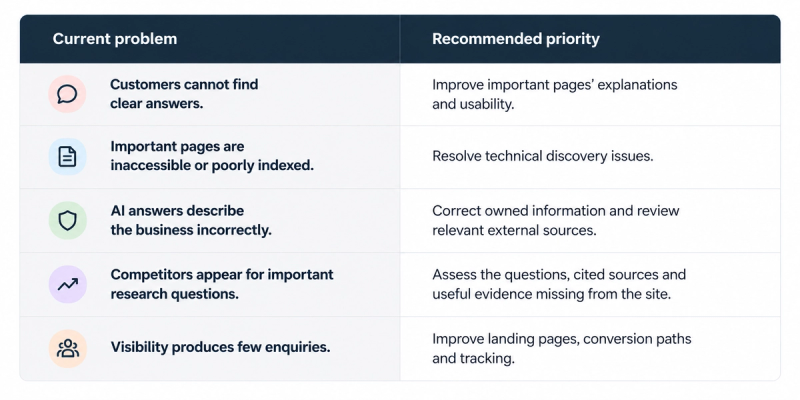
For example, if a business already ranks well for important service keywords but receives limited enquiries, publishing more explanatory content might not solve its main problem.
The website may need clearer service information, stronger evidence or a more effective conversion journey.
Alternatively, a business with weak technical foundations may struggle to gain visibility regardless of how carefully its content is formatted.
This is why we recommend beginning with a review of existing search performance, website content and customer behaviour.
From there, prioritise the changes most likely to address the real issue.
How should you measure GEO and AEO performance?
Traditional SEO reporting often focuses on rankings, impressions, clicks and organic traffic.
These metrics remain valuable, but answer-based search introduces additional ways to evaluate visibility.
A business may appear in an AI response without receiving a website visit. It may also receive traffic from AI search without being able to attribute every preceding interaction.
A practical measurement framework should distinguish different outcomes.
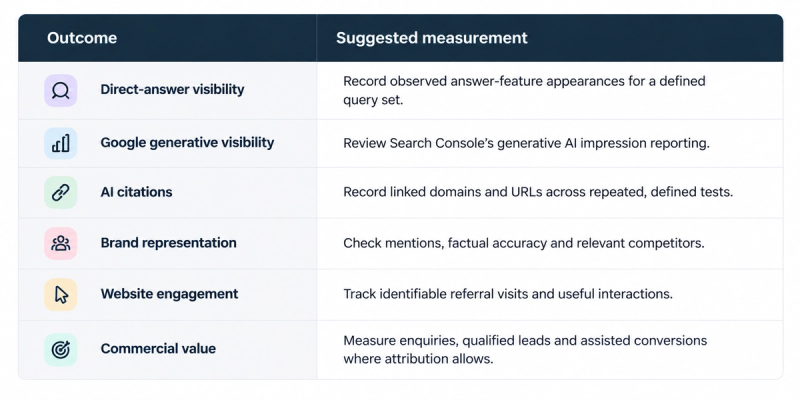
Measuring AI visibility in Google Search Console
Google introduced dedicated Generative AI performance reports in Search Console in June 2026, with worldwide rollout completed by 31 August 2026.
The Search report provides impression data for AI Overviews and AI Mode, including visibility by page, country, device and date.
However, the dedicated report does not provide a complete picture of AI-driven clicks or commercial outcomes.
Some properties may also have insufficient impressions for the report to appear.
For that reason, businesses should review Search Console alongside website analytics and conversion data.
Read Google's Generative AI performance report guidance for the available reporting dimensions.
Measuring citations and brand representation
For other AI search experiences, a repeatable testing process can provide useful directional insights.
Start with a defined set of questions your customers commonly ask.
Then record:
- The platform and search experience tested.
- The exact question or prompt.
- The date, location and language.
- Whether the brand was mentioned.
- Whether the website received a linked citation.
- Which competitors appeared.
- Whether the information was accurate.
Repeat the tests under comparable conditions and review patterns over time.
Results can vary by platform, prompt, location, account and date, so sampled testing should not be presented as a complete measure of AI search visibility.
Measuring commercial value
A mention is not the same as a citation. A citation is not the same as a visit. And a website visit is not necessarily a qualified enquiry.
These distinctions matter when assessing whether visibility contributes to business growth.
Businesses should connect identifiable AI referrals with engagement and conversion data where possible.
This might include contact form submissions, purchases, consultation requests or other valuable customer actions.
Attribution will not always be complete, particularly when someone encounters a brand through AI search and later returns through another channel.
The goal is to understand meaningful trends rather than claim precision that the available data cannot support.
How Flight connects search visibility with business outcomes
At Flight Digital, we don't believe SEO, GEO and AEO should operate as disconnected strategies.
Your customers don't think in acronyms. They ask questions, compare options and look for businesses they can trust.
Our role is to help make those connections easier.
That means bringing together several areas of expertise.
Audience research and content planning
We identify the questions customers ask and the information they need at different stages of their journey.
Technical SEO and website architecture
We make sure important content can be discovered, accessed and understood by relevant search systems.
Clear business information and original expertise
We help organisations explain their capabilities, experience and points of difference through useful, credible content.
User experience and conversion
Visibility matters, but what happens after someone reaches the website is just as important.
Measurement and improvement
We connect rankings, AI visibility, organic traffic, engagement and commercial actions to understand where improvements are needed.
Our SEO and GEO approach brings these areas together as part of a wider digital performance strategy.
The goal isn't to optimise a website for one search feature and hope for the best.
It's to build a digital presence that remains useful, discoverable and commercially effective as search behaviour changes.
Make your business easier to find and understand
GEO and AEO are two ways of describing an increasingly connected challenge: helping people and search systems find accurate, useful information.
AEO places more emphasis on delivering direct answers. GEO focuses on visibility and representation within AI-generated responses.
Both depend on strong SEO foundations, credible information and content that genuinely addresses customer needs.
For New Zealand businesses, the priority should be improving those foundations before creating separate strategies around emerging terminology.
At Flight Digital, we connect content, SEO, technology and customer experience to help organisations build visibility that supports real business goals.
Whether you're assessing your AI search presence, reviewing existing content or planning a wider search strategy, talk to the Flight Digital team about where your biggest opportunities may be.