
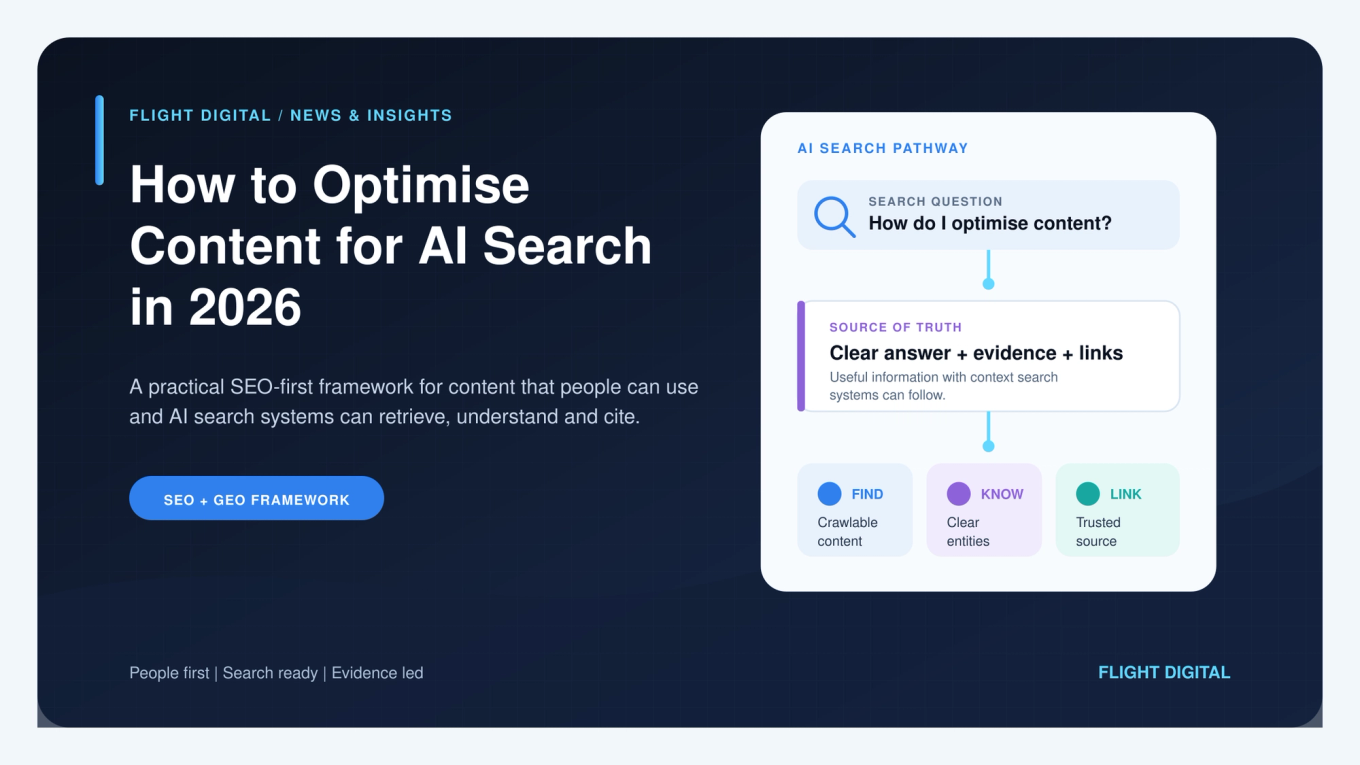
What does it mean to optimise content for AI search?
AI search optimisation means improving the usefulness, clarity, accessibility and authority of content so it can be discovered and used across modern search experiences. That includes traditional Google results, Google AI Overviews, Google AI Mode and conversational search experiences such as ChatGPT Search and Perplexity.
The important distinction is that AI search optimisation is not a replacement for search engine optimisation. Google’s current guidance says its generative AI features are grounded in core Search systems, so established SEO practices remain relevant. A page still needs to be accessible, indexable, useful and eligible to appear in Search before it can be considered as a supporting source in Google’s AI features.
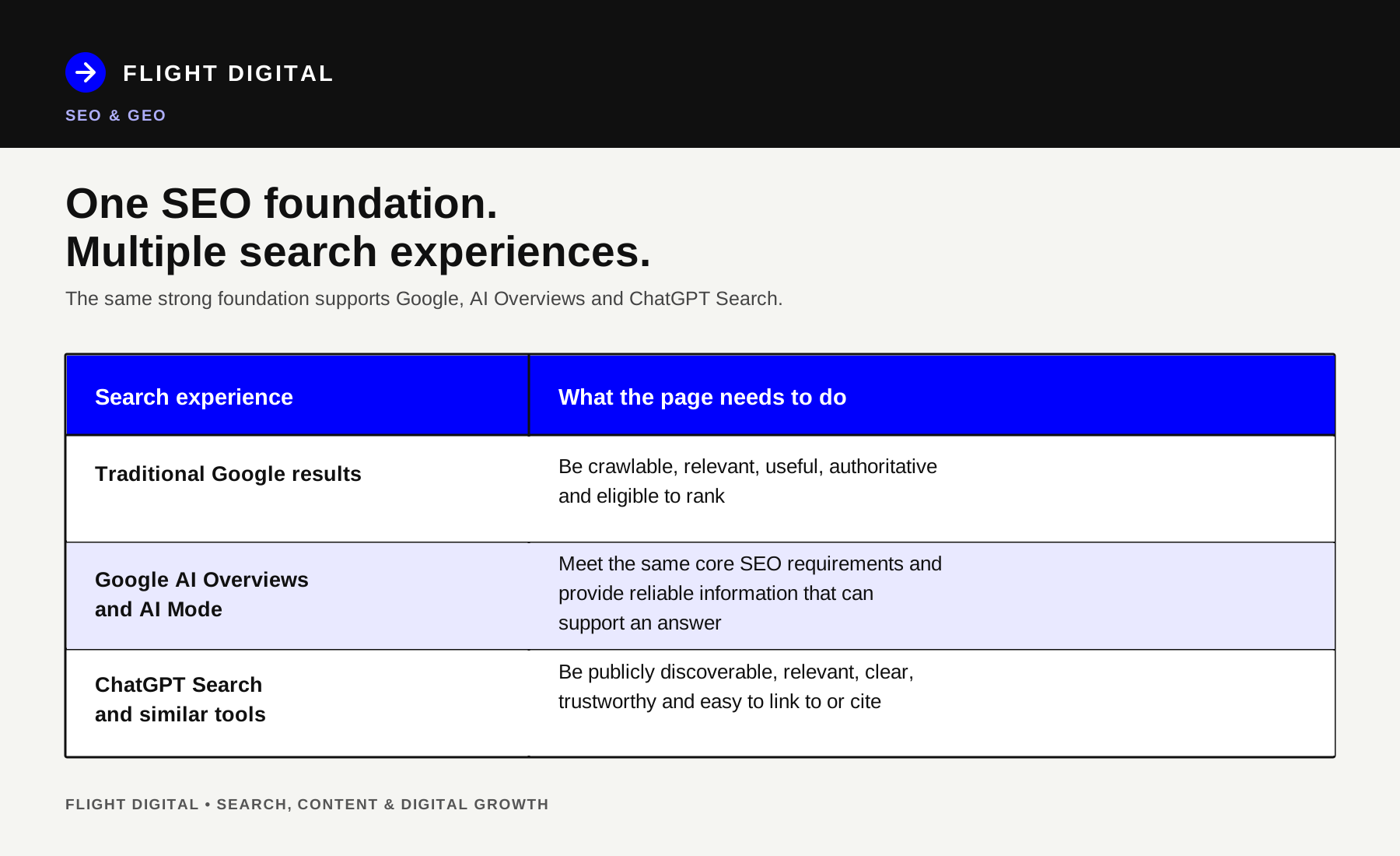
The systems do not all retrieve or present information in exactly the same way. Google describes retrieval-augmented generation and query fan-out, while other systems use their own crawlers, indexes, models and selection processes. There is no single universal AI ranking factor.
That is why GEO, or generative engine optimisation, is best treated as an additional visibility and measurement layer around SEO. See Flight Digital’s SEO vs GEO guide for a deeper comparison. The goal is content that people can use and search systems can retrieve, interpret and connect to a reliable source.
Flight’s six-part framework for AI-search-ready content
1. Start with the real question, not a keyword list
The first step is to understand what the reader is trying to accomplish. A keyword may describe the wording of a search, but it does not always explain the task behind it. Someone searching “how to optimise content for AI search” may be looking for a checklist, a technical audit, a content process, a way to measure visibility or help deciding whether to engage an agency.
Build a small intent map before writing. Identify the main question, the likely follow-up questions, the reader’s concerns, the decision criteria and the next action the page should support. Include awareness, comparison and action needs where they belong, but do not force every possible query into one article.
For example, an Auckland organisation may ask whether it needs SEO, GEO or both. The useful answer is not a separate page for every variation of that question. It is a clear explanation of how technical SEO, content quality, entity clarity, UX and AI-search measurement work together, followed by a link to an SEO agency in Auckland for readers who need help applying it.
Use query fan-out as a planning prompt, not a publishing rule. It can reveal related concerns such as citations, AI Overviews, technical access and brand visibility. Create a new page only when the intent, audience or task is meaningfully different. Otherwise, improve the existing source-of-truth page and clarify the relationship between pages.
2. Answer the question before adding depth
AI-search-ready writing starts with a direct answer. Do not make the reader work through a history of artificial intelligence or a broad prediction about the future of search before they reach the point.
A useful structure is:
- Give the direct answer in the first sentence or paragraph.
- Explain the reasoning and context.
- Add practical steps, examples or evidence.
- State limitations, exceptions or next actions.
This is not the same as breaking every page into tiny blocks for an AI system. It is simply good information design. Use descriptive headings, short paragraphs, ordered steps, bullets and tables when they help a person understand the topic. Each important section should still make sense if someone arrives directly from a search result or an AI-generated link.
Compare these two openings:
Weak: “AI search is changing digital marketing and businesses need to adapt.”
Stronger: “To optimise content for AI search, make the page crawlable, answer the target question directly, support important claims with evidence and connect the page to related content through clear internal links.”
The stronger version gives the reader a usable answer immediately. The following paragraphs can then explain why those actions matter, how to apply them and where the limits are.
3. Add information that could not have come from any generic article
Generic advice is easy to produce and difficult to trust. If a page repeats the same checklist as every other result, it gives searchers little reason to choose it and gives AI systems little distinctive information to retrieve.
Add evidence that comes from genuine knowledge of the subject. That may include:
- first-hand observations from projects or audits
- original data, analysis or documented decisions
- a repeatable internal process
- practical examples showing the before and after reasoning
- clear limitations and conditions
- approved case-study evidence
- dated sources and attribution for external claims
For a digital agency, useful evidence might show how a content opportunity was prioritised, a technical issue diagnosed, internal links reorganised or a platform change measured. Explain what was done, why it mattered and what can reasonably be learned.
Flight Digital’s work across SEO, content-led platforms, UX, headless architectures, migrations and measurement creates opportunities for this type of practical insight. Where the evidence is approved, the Active Adventures case study can support discussion of structured content and technical discoverability. The Sneaker Freaker case study can support discussion of content operations, platform performance and how a digital experience helps people find and use information.
Do not invent a percentage, award, quote or client outcome to make a page sound authoritative. A specific process with honest limits is more useful than an impressive but unverified claim.
4. Make the topic and entities clear
AI systems need context, not just repeated keywords. They need to understand what an organisation is, what it offers, which concepts are related and which page is the most authoritative source for each topic.
Define important terms when they first appear. For example:
- SEO is the practice of improving a website’s ability to be discovered and understood in search engines.
- GEO is a commonly used term for work intended to improve visibility in generative or AI-assisted search experiences.
- AI Overviews and AI Mode are Google Search experiences that can provide generated responses with links to supporting websites.
- Retrieval-augmented generation, or RAG, uses retrieved information to ground a generated response.
- Query fan-out refers to related searches generated or expanded around a user’s original question.
Then explain the relationships between them. A page about AI-search content optimisation should connect the topic to technical SEO, content strategy, internal linking, structured content, UX and measurement. It should not treat GEO as an isolated acronym or suggest that repeating “AI search” more often creates authority.
Use consistent names for your organisation, services, platforms, locations and products. Link to the most authoritative related page with descriptive anchor text, and keep the article’s purpose distinct from nearby pages.
5. Build a technically accessible page
Content cannot be cited if the relevant page cannot be crawled, indexed or rendered reliably. Technical accessibility is not separate from AI-search optimisation. It is one of the conditions that makes the content available in the first place.
For an important article, check that it:
- returns a successful 200 status
- has one clear canonical URL
- can be crawled and indexed where appropriate
- is included in the XML sitemap
- is linked from relevant pages on the site
- provides its main content as text in the rendered page
- does not hide important information behind inaccessible interactions
- uses accessible headings, lists, tables and image alt text
- works well on mobile and does not create avoidable page-performance friction
- is not unintentionally blocked by robots rules, a CDN, firewall or hosting configuration
JavaScript does not automatically make a page unavailable, but important content still needs to be rendered and accessible to the relevant crawler. Check what users and search systems receive, not only the development view.
For Google AI features, Google says a page must be indexed and eligible to appear with a snippet in Search. Meeting those requirements does not guarantee crawling, indexing, serving or inclusion. For ChatGPT Search, site owners should confirm that they have not unintentionally blocked OAI-SearchBot in robots.txt. OpenAI describes OAI-SearchBot as the crawler used to surface websites in ChatGPT search results, but allowing it is an eligibility consideration, not a ranking guarantee. OpenAI crawler guidance.
6. Connect, measure and maintain the content
Publishing is the beginning. A useful article should sit inside a clear information architecture and lead readers to the next piece of information or action.
Link to the commercial source of truth, such as Flight’s SEO agency in Auckland, when the reader needs implementation support. Link to SEO content velocity when the discussion moves to publishing operations. Link to website development and digital platforms, Sanity CMS development or a relevant case study only when the context genuinely helps the reader.
Measure more than rankings. A practical measurement set can include:
- Google Search Console impressions, clicks, CTR and queries
- organic rankings for the main query and close variants
- indexation, crawl status and technical errors
- AI Overview or AI Mode visibility where the data is available
- brand mentions and cited URLs in a controlled prompt set
- AI-referred sessions and engaged sessions in GA4
- form starts, enquiries and qualified leads in the CRM
- whether the brand information appearing in AI responses is accurate
Record the date, location, device, prompt and cited sources whenever AI visibility is tested. Results can vary by context, so one prompt check is a snapshot, not proof of performance.
A practical Flight Digital workflow
At Flight Digital, AI-search content work sits inside a wider digital system. We connect search strategy with UX, content, technology, analytics and the platform supporting the experience.
1. Discover
We begin with the business goal, audience questions, search demand, competition, current visibility and technical constraints. This distinguishes a genuine opportunity from a page that needs better structure, evidence or internal links.
Discovery also considers the action that matters after the visit, such as a qualified enquiry, product interaction, subscription, resource download or sales conversation. The content should support that journey without becoming an aggressive sales page.
2. Map
We connect the target topic to entities, search intent, existing pages and the customer journey. This mapping identifies the page that should act as the source of truth, the supporting articles that should strengthen it and the internal links that should connect the cluster.
It prevents unnecessary content expansion. A site does not need a new page for every phrasing of a question; it needs a clear structure in which each page has a useful job.
3. Build
We create or improve the content with a direct answer, clear headings, original expertise, useful examples and evidence that can be checked. The writing should be understandable to a decision maker while still giving technical and content teams enough detail to act on.
Content quality and user experience meet here. A strong article is easier to scan, navigate and maintain. It does not bury the answer under an introduction written for a keyword tool.
4. Enable
The CMS, templates, rendering, metadata, structured data and measurement should support the content after publication. That includes making key text available in the rendered page, creating reusable fields where appropriate, supporting editors with a practical workflow and ensuring analytics can connect content engagement with commercial outcomes.
For organisations planning a CMS migration or replatform, this step matters even more. A new platform should make content clearer and more maintainable, not introduce hidden indexation, redirect or measurement problems.
5. Validate
Before publication, we check facts, sources, internal links, canonicalisation, indexability, accessibility, mobile UX, forms and conversion paths. We also review the page as a reader: does it answer the question quickly, explain its limits and help someone decide what to do next?
Validation continues after launch. Search Console, analytics, crawl data and user behaviour can reveal problems that were not visible in staging.
6. Learn
We monitor organic visibility, AI-search visibility, referrals, engagement, enquiries and qualified leads. Where prompt testing is used, we repeat it consistently rather than reacting to one answer generated on one day.
The findings inform the next priority. That may be improving the article, strengthening a source-of-truth capability page, fixing a technical issue, adding first-party evidence or changing the internal-link path. This is how content becomes part of continuous digital improvement rather than a one-off publication task.
What not to do when optimising for AI search
AI search has created a new vocabulary and a lot of confident advice. Some of it is useful. Some of it turns reasonable information-design principles into supposed ranking hacks.
- Do not promise a guaranteed place in AI answers. No agency can control every retrieval, model response, location, device or prompt.
- Do not assume llms.txt is required for Google AI visibility. Google’s current guidance says Google Search does not use llms.txt or special AI files as a requirement for generative AI visibility. Organisations may maintain such files for other systems, but they do not replace technical SEO or useful content.
- Do not chase an ideal word count. There is no universal length that makes a page eligible for AI search. Write enough to answer the reader’s task properly, then remove repetition.
- Do not split one useful page into many tiny pages only to target related prompts. A high volume of pages is not a substitute for relevance and can create a poor user experience or duplicate intent.
- Do not repeat synonyms instead of adding meaning. Clear language and related terms should help readers, not create a wall of variations.
- Do not treat structured data as a magic AI signal. Structured data should accurately describe visible content and support eligible Search features. It is useful SEO infrastructure, not a guarantee of citations.
- Do not manufacture authority. Inauthentic mentions, low-quality guest posts and manufactured citations are not a durable trust strategy.
- Do not publish unreviewed AI drafts. If AI assists with drafting, people still need to check facts, sources, originality, tone, accountability and compliance with Search policies.
The useful distinction is simple: format content clearly for humans, then make the site technically accessible and semantically coherent. Do not try to manipulate retrieval with artificial formatting.
How to measure whether content is working in AI search
AI-search performance is not one number. A page can be technically eligible but receive little visibility, appear in an answer but send no meaningful traffic, or attract visits without generating useful actions. A measurement framework should show where the opportunity or weakness sits.
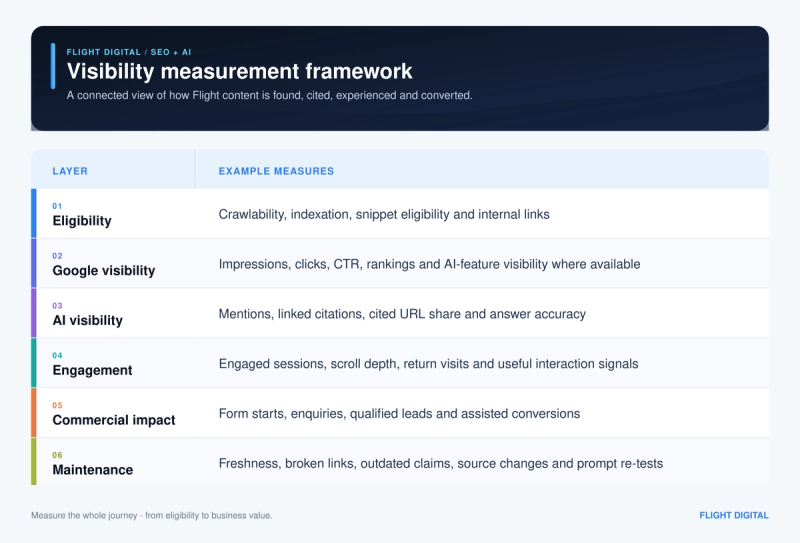
For Google, Search Console remains important. Google says AI-feature traffic is included in overall web-search reporting and has introduced a Generative AI performance report where available. Combine this with GA4 and CRM data to distinguish visibility from business impact.
For other AI systems, create a controlled prompt set and repeat it over time. A useful starting set for Flight Digital’s internal monitoring could include:
- How do I optimise content for AI search?
- How can a New Zealand business appear in Google AI Overviews?
- What is the difference between SEO and GEO?
- How do I make content easier for ChatGPT to cite?
- Which Auckland agency combines SEO, content, UX and AI search visibility?
Record the prompt, date, location, device, response, mentioned brands, cited URLs and answer accuracy. Compare observations with Search Console, GA4 and CRM data. One prompt test cannot prove performance, but repeated tests can identify trends and errors.