
Sanity and Silverstripe can both power sophisticated websites, but they approach content management very differently.
Silverstripe is an open-source CMS and development framework traditionally used to build integrated websites and applications. Sanity is a structured content platform built around APIs, flexible content models and headless architecture.
The right choice depends on your existing technology, content requirements, development resources, integrations and how your digital ecosystem may need to evolve.
Below, we compare Sanity vs Silverstripe across architecture, content management, development, SEO, scalability, integrations and use cases.
Sanity and Silverstripe can both power sophisticated websites, but they approach content management very differently.
Silverstripe is an open-source CMS and development framework traditionally used to build integrated websites and applications. Sanity is a structured content platform built around APIs, flexible content models and headless architecture.
The right choice depends on your existing technology, content requirements, development resources, integrations and how your digital ecosystem may need to evolve.
Below, we compare Sanity vs Silverstripe across architecture, content management, development, SEO, scalability, integrations and use cases.
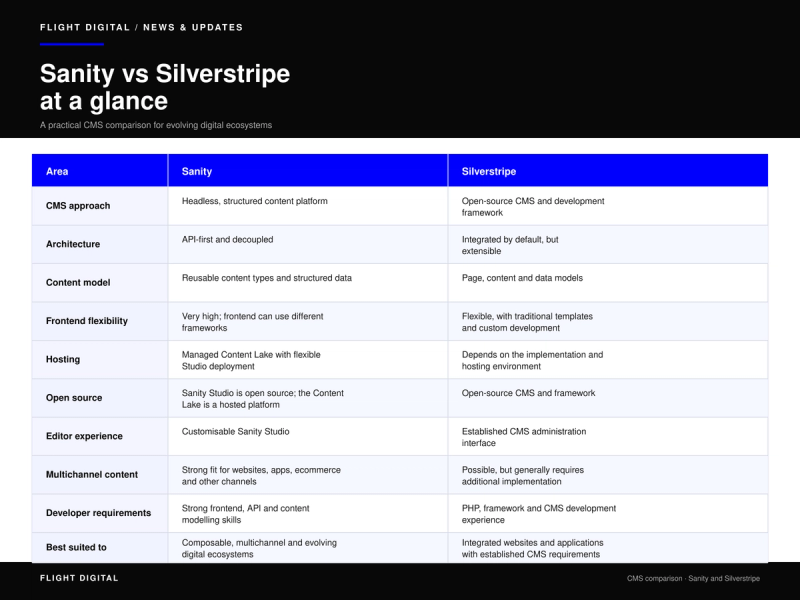
These are common implementation patterns rather than fixed limitations. Both platforms can be customised, and the quality of the final website depends heavily on how the CMS, frontend and integrations are designed.
What is Sanity CMS?
Sanity is a headless content management platform built around structured content. Content is stored independently from the website frontend and delivered through APIs to websites, applications, ecommerce platforms and other digital experiences.
Sanity includes:
- Sanity Studio, a customisable editing environment
- The Content Lake, where structured content is stored
- APIs for querying and delivering content
- Flexible content modelling
- Support for reusable and connected content
- Tools for collaboration, preview and publishing workflows
Instead of treating every webpage as a separate document, Sanity allows content teams and developers to model content as reusable data.
For example, an organisation could create structured content types for:
- Services
- Team members
- Locations
- Products
- Case studies
- Events
- Articles
That content can then be reused across different pages, websites, apps or digital channels.
Sanity Studio can also be customised around the way a content team works. This makes it possible to create a more tailored editorial experience instead of relying solely on a generic CMS interface.
You can learn more about Sanity CMS development or read five reasons Flight chose Sanity CMS.
What is Silverstripe CMS?
Silverstripe CMS is an open-source content management system and development framework. It is built using PHP and can be customised for websites, digital platforms and web applications.
Silverstripe traditionally combines content management and application development more closely within the same website architecture. Developers can create custom page types, fields, templates, modules and functionality to meet the needs of an organisation.
Flight’s Silverstripe development capability supports new builds, custom functionality, upgrades, migrations and ongoing support for organisations across New Zealand.
Silverstripe is often suited to organisations that want:
- An established CMS and page management experience
- A flexible PHP-based development framework
- Custom content fields and data structures
- Integrated website and application functionality
- Control over hosting and deployment
- An open-source technology stack
- A platform that can be extended over time
Silverstripe is not automatically outdated simply because newer headless platforms exist. It can remain a strong choice when its architecture aligns with the organisation’s team, content model and website requirements.
What is the main difference between Sanity and Silverstripe?
The biggest difference between Sanity and Silverstripe is how content relates to the frontend.
Sanity treats content as structured data that exists independently from a specific website presentation. The frontend retrieves that content through APIs and decides how it should be displayed.
Silverstripe traditionally combines the CMS, website templates and application logic more closely. Content is usually managed within the website application and presented through the platform’s templates and frontend architecture.
In practical terms:
- Sanity separates content from presentation.
- Silverstripe generally connects content management and presentation more closely.
- Sanity is designed for content reuse across multiple channels.
- Silverstripe is often efficient for integrated websites and applications.
- Sanity gives frontend teams greater freedom over the technology stack.
- Silverstripe provides a more unified CMS and development environment.
Neither approach is automatically better. The best choice depends on whether your organisation primarily needs a powerful website CMS or a broader content platform that can support multiple digital experiences.
Sanity vs Silverstripe for content management
The most important question is:
Do you primarily manage webpages, or do you need content to exist independently from individual webpages?
Sanity is particularly strong when content needs to be reused. A product, service, location or team member can be created once and displayed in several places without duplicating the underlying information.
This can make content easier to maintain across:
- Multiple websites
- Mobile applications
- Ecommerce experiences
- Regional websites
- Personalised customer journeys
- Digital directories
- Future channels
Sanity’s structured approach also makes it easier to define relationships between different content types. For example, a service can be connected to relevant industries, locations, case studies and team members.
Silverstripe is often a natural fit for page-based content management. Editors can manage website pages, navigation structures and custom fields through an established CMS interface. Developers can also extend the CMS to support more specialised workflows and data models.
The main difference is the starting point. Sanity starts with structured, reusable content. Silverstripe traditionally starts with the website and its content hierarchy.
Sanity vs Silverstripe for developers
Sanity gives developers a high degree of frontend freedom. A website can be built using technologies such as React, Next.js or other modern frontend frameworks, while Sanity manages the content layer behind it.
This can support:
- Separate frontend and backend deployments
- API-driven development
- Modern performance strategies
- Reusable components
- Multiple frontend applications
- Flexible hosting options
- Integration with external digital services
The trade-off is that more responsibility sits with the development team. Developers need to plan the content model, frontend rendering, preview experience, routing, metadata, redirects and integrations carefully.
Silverstripe provides a more integrated development model. Teams with PHP and Silverstripe experience can build custom websites, templates, modules and application functionality within one broader platform.
This can reduce complexity for projects where the CMS and frontend need to work closely together. It can also make Silverstripe a practical choice for organisations with existing PHP expertise or a long-standing Silverstripe codebase.
The better option depends on your development team. Sanity may suit teams that want a modern API-first architecture and frontend flexibility. Silverstripe may suit teams that prefer a unified PHP-based CMS and application framework.
Which CMS is better for structured content?
Structured content stores information as reusable fields and content types rather than treating every webpage as a standalone document.
For example, instead of writing a team member’s information directly into one page, structured content might store their:
- Name
- Role
- Biography
- Image
- Location
- Areas of expertise
- Related work
That information could then be displayed on a team page, service page, case study or mobile application.
Sanity is particularly well suited to this model because structured content is central to its architecture. Its Content Lake stores content as data that can be queried, connected and delivered to different channels.
Silverstripe can also support structured data and custom content models. However, the implementation is usually more closely connected to the website or application being built.
Sanity is generally the stronger fit when your organisation needs extensive content reuse, multiple websites, localisation, personalisation, ecommerce integration or new digital channels.
Sanity vs Silverstripe for headless architecture
A headless CMS separates the content management system from the frontend presentation layer.
The CMS manages and stores content. The frontend retrieves that content through APIs and displays it using the organisation’s chosen technology.
Sanity is headless by design. This makes it a natural fit for websites and applications where content needs to be delivered across more than one frontend.
Silverstripe can also support decoupled or headless implementations through APIs, custom development and additional integrations. However, this is not the traditional model around which its CMS experience was originally designed.
Headless architecture can provide more flexibility, but it also requires careful planning. The development team needs to manage areas such as:
- Frontend rendering
- Preview functionality
- URL routing
- Metadata
- Structured data
- Internal linking
- Redirects
- XML sitemaps
- Analytics
- Content workflows
Read more about JAMstack and headless architecture and headless CMS SEO.
Which CMS is better for SEO?
Both Sanity and Silverstripe can support strong SEO. Search performance depends more on the website’s architecture, content and implementation than on the CMS name itself.
A well-built website should provide control over:
- Page titles and meta descriptions
- Heading structures
- Canonical URLs
- XML sitemaps
- Redirects
- Structured data
- Internal links
- Image optimisation
- Crawlability
- Rendering
- Core Web Vitals
With Sanity, developers have significant control over the frontend and performance strategy. However, technical SEO requirements need to be deliberately implemented in the frontend.
Silverstripe can also support crawlable, technically sound websites. Its integrated architecture may make some page-level controls more straightforward, but SEO still depends on the quality of the templates, content, code and technical configuration.
Neither platform guarantees rankings. A CMS provides the tools; the website team needs to use them correctly.
Which CMS is easier for content teams?
The better editor experience depends heavily on how each CMS has been configured.
Sanity Studio can be customised around the content team’s workflows. It can provide structured fields, custom validation, reusable content, collaboration tools and tailored editorial interfaces.
This can be powerful for organisations with complex content requirements, but it may feel different from a traditional page editor. The content model needs to be planned clearly so editors understand how content is created, connected and reused.
Silverstripe provides a more conventional CMS experience for managing pages and website content. It can also be customised with additional fields, workflows and functionality.
Silverstripe may be easier for teams that think primarily in terms of webpages and site sections. Sanity may be better for teams that manage content as reusable information across several digital experiences.
Sanity vs Silverstripe for integrations
Modern organisations rarely use their CMS in isolation. It may need to connect with:
- CRM platforms
- Ecommerce systems
- Search tools
- Analytics platforms
- Marketing automation
- Personalisation platforms
- Customer data platforms
- Mobile applications
- Third-party APIs
Sanity’s API-first model makes it well suited to a composable technology stack, where different specialist platforms work together. Content can be queried and delivered to the systems that need it.
Silverstripe can also integrate with external platforms through modules, APIs and custom PHP development. Its integrated architecture can be useful when business logic and website functionality need to live within the same application.
The right choice depends on the role you want your CMS to play. If it needs to be one component within a wider digital ecosystem, Sanity may be a strong fit. If the CMS needs to sit at the centre of an integrated website application, Silverstripe may be more practical.
Which CMS is more scalable?
Scalability is not only about handling more website visitors. It can also mean managing more content, brands, markets, editors, integrations and digital channels.
Sanity can be a strong option for organisations that expect to:
- Publish content across multiple websites
- Support multiple regions or languages
- Reuse content across channels
- Add new frontend experiences
- Integrate with several third-party systems
- Build content-rich ecommerce experiences
- Personalise digital journeys
Silverstripe can also support large and complex websites, particularly when the organisation has an established Silverstripe team and a well-maintained technical foundation.
Traffic scalability depends on factors such as hosting, caching, frontend implementation, database design and code quality. The CMS alone does not determine how well a website will scale.
When should you choose Silverstripe?
Silverstripe may be the better choice when:
- Your organisation already has a strong Silverstripe investment
- Your team has PHP and Silverstripe expertise
- Your website and application functionality need to be closely integrated
- Your content is primarily page-based
- Your existing website performs well
- Migration would create more cost and risk than value
- Your organisation prefers an open-source CMS and framework model
A technology decision should not be based on replacing a platform simply because another platform is newer. If Silverstripe meets your requirements and is being maintained effectively, staying on the platform may be the most sensible decision.
If Silverstripe aligns with your organisation’s needs, Flight can help assess, develop and support the platform through its Silverstripe developers in New Zealand capability.
When should you choose Sanity?
Sanity may be the better choice when:
- You need structured and reusable content
- You are building multiple websites or digital channels
- You want greater frontend independence
- Your organisation is moving towards a composable architecture
- You need extensive integrations
- Your content ecosystem is becoming more complex
- You are building content-rich ecommerce experiences
- You expect your digital requirements to change over time
If you are considering Sanity for a rebuild or digital transformation project, Flight can help assess the content model, architecture, frontend requirements and implementation plan through its Sanity CMS development capability.
Should you migrate from Silverstripe to Sanity?
Moving from Silverstripe to Sanity can make sense when your existing architecture is limiting content reuse, integrations, frontend development or the ability to support multiple digital experiences.
However, migration should solve a real business or technology problem. It should not happen simply because Sanity is newer or because headless architecture is currently popular.
A Silverstripe-to-Sanity migration may involve:
- Auditing the existing website and content
- Defining the new content model
- Mapping existing content to new content types
- Planning the frontend architecture
- Rebuilding templates and components
- Reviewing integrations and APIs
- Mapping URLs and metadata
- Implementing 301 redirects
- Recreating structured data
- Testing analytics and conversion tracking
- Testing crawlability and indexation
- Monitoring performance after launch
SEO needs to be considered from the beginning. A migration should protect valuable URLs, content, internal links, metadata and search visibility wherever possible.
You can also review Flight’s website development capability, SEO services, and Shopify and headless commerce capability.
How Flight approaches CMS decisions
Choosing between Sanity and Silverstripe should start with your organisation’s content, technology and growth requirements, not simply with whichever platform is newest.
At Flight, we assess:
- How content needs to be structured, reused and governed
- Whether the frontend should be integrated or decoupled
- How the CMS will connect with ecommerce, CRM, analytics and other systems
- How SEO requirements will be handled across templates, content and technical architecture
- What your internal team can manage and maintain
- Whether migration would create genuine business value
Sometimes the right recommendation is to stay with an existing CMS and improve its architecture. In other cases, a new platform may provide the flexibility needed for future growth.
Flight brings more than x years of digital platform experience across strategy, UX, development, ecommerce, SEO and content systems. Our Sanity CMS development capability and experience with headless CMS SEO reflect this wider approach.
The goal is not to force every organisation towards Sanity. It is to recommend a CMS and digital architecture that supports how your organisation works today and where it needs to go next.
Sanity vs Silverstripe: Which should you choose?
Choose Silverstripe when its established CMS and development framework align with your existing technology, team and website requirements.
Consider Sanity when you need structured content, greater frontend flexibility, content reuse across multiple experiences or a more composable digital architecture.
Ultimately, the better CMS is the one that supports your organisation’s content, customer and technology requirements without creating unnecessary complexity.
If you are evaluating Sanity as part of a website rebuild or CMS migration, Flight can help assess the architecture, content model and implementation requirements before a platform decision is made.