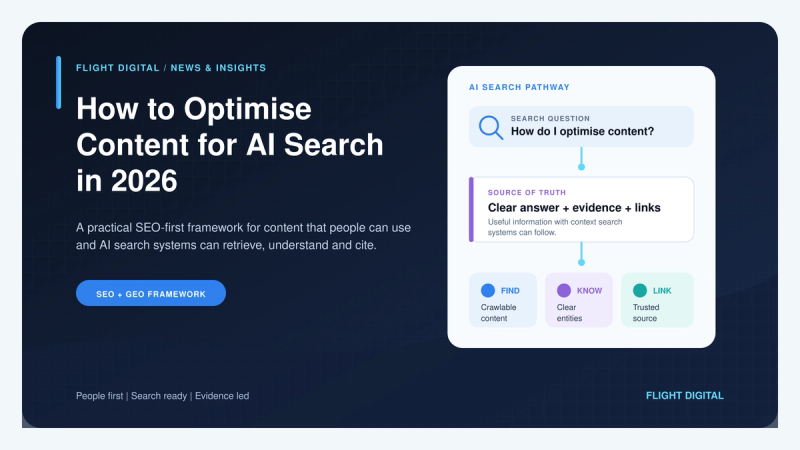

SEO and GEO are not opposites. SEO helps search engines crawl, understand and rank useful content. GEO, or generative engine optimisation, focuses on whether AI systems select, summarise, cite or mention your brand within generated answers. The same foundations still matter: technical accessibility, useful content, authority, clear entities and a good user experience. What changes is the format of discovery, the role of supporting sources and how visibility is measured. For Google AI Overviews and AI Mode, Google says this work remains SEO, so GEO is best understood as an additional visibility layer, not a replacement.
AI search is already changing how people research businesses, products, services and complex questions. In July 2025, Alphabet reported that AI Overviews had more than 2 billion monthly users across more than 200 countries and territories and 40 languages. Alphabet also reported that AI Overviews were driving more than 10% additional queries globally for the types of searches where they appear.
These figures are global and dated, not a current measurement of New Zealand usage. They do show why businesses need to understand how visibility works when search results become more conversational, synthesised and answer led.
SEO vs GEO: What Is the Difference?
SEO primarily helps a website become discoverable and perform in traditional search results. GEO focuses on how a brand, page or source appears within generated answers across AI search experiences.
The two approaches overlap heavily. GEO does not remove the need for technical SEO, useful content, authority or a well structured website. Instead, it adds another way to think about visibility, source selection, brand accuracy and measurement.
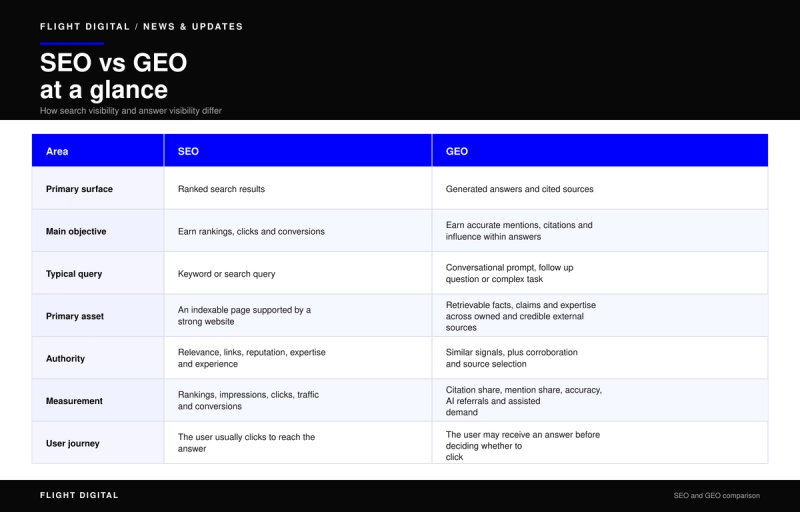
A business should not create two disconnected strategies with separate content, technical work and priorities. The strongest approach is usually one joined search strategy that improves the website for people, search engines and emerging AI experiences.
What Is SEO?
Search engine optimisation is the process of improving how search engines discover, understand and rank a website’s content. It also involves helping the right people find the site and take meaningful action once they arrive.
A strong SEO strategy can include:
- Technical audits and indexation
- Website architecture and internal linking
- Keyword and search intent research
- Content strategy and optimisation
- Structured data
- User experience
- Authority and digital reputation
- Conversion paths and measurement
SEO is not only about adding keywords to a page. It is about making the relationship between the organisation, its services, its audience and its content clear.
Flight Digital brings these areas together through SEO strategy and implementation, helping organisations build digital platforms that are discoverable, useful and able to support long term growth.
What Is Generative Engine Optimisation?
Generative engine optimisation is a term used to describe work that aims to improve how a brand, source or piece of content appears within AI generated answers.
This can include improving:
- Brand and entity clarity
- Answer first content
- Source quality and citations
- First hand expertise
- Content structure
- Supporting evidence
- Consistent information across the web
- Visibility across selected AI search platforms
GEO is still an emerging term rather than a single agreed technical standard. It is often used alongside related terms such as answer engine optimisation, AI search optimisation and generative search optimisation.
The original GEO research paper introduced a framework for improving visibility in generative engine responses. In its experiments, the researchers reported visibility improvements of up to 40% across a broad benchmark and up to 37% in a Perplexity test. These were controlled research findings, not guaranteed commercial outcomes. The study itself also shows that the effectiveness of different methods varies by topic, query and domain.
The useful takeaway is not that every page should be rewritten using a GEO formula. It is that clear evidence, relevant statistics, credible sources and useful information can help systems understand and represent content more accurately.
What Changes When Search Generates the Answer?
From a list of results to a synthesised response
Traditional search usually presents a list of pages for the user to evaluate. A generative system may retrieve information from several sources and combine it into one response.
This means a page can influence an answer without holding the traditional number one position. It may be used as a supporting source, cited for a specific claim or used to help the system understand a wider topic.
This does not make rankings irrelevant. Strong organic visibility can still help a page become discoverable and eligible for retrieval.
From one query to several related searches
Google describes a process called query fan out, where AI features issue several related searches across different subtopics and data sources before forming a response.
For example, a search about choosing an SEO agency may lead to related searches about services, pricing, locations, experience, technical capability and results.
This makes complete topic coverage and sensible internal linking more useful than creating a thin page for every keyword variation. A well planned content cluster can answer the main question while also supporting the related questions that influence the decision.
From rankings to citations and source selection
Traditional SEO often focuses on where a page appears in a results page. AI search adds questions such as:
- Was the brand mentioned?
- Was the page cited?
- Was the source used to support a specific claim?
- Was the information represented accurately?
- Did a competitor appear instead?
- Did the answer encourage further research?
Different AI platforms retrieve, summarise and cite information in different ways. There is no universal ranking position for every generated response.
From owned content to wider corroboration
AI systems may use information from a range of sources. A brand’s own website matters, but so can credible external coverage, expert commentary, reviews, industry profiles and consistent business information.
This does not mean businesses should manufacture mentions or pursue low quality digital PR. Inauthentic mentions can create noise rather than trust.
The better approach is to make important facts consistent, publish genuine expertise and earn relevant recognition through useful work and credible sources.
From click based visibility to mixed visibility
Some users will click a citation to verify information or explore a source. Others may use the answer without visiting the website immediately.
This means reporting should consider more than organic sessions. A complete view may include:
- Search visibility
- AI citations
- Brand mentions
- Branded searches
- Referral visits
- Engagement
- Leads
- Assisted conversions
- Revenue influence
The role of traffic has not disappeared. It now sits alongside other signals of visibility and influence.
What Does Not Change Between SEO and GEO?
The foundations remain largely the same.
Crawlability and indexation
A page needs to be accessible, crawlable and eligible for inclusion in search results. Google states that pages must be indexed and eligible to appear with a search snippet before they can appear as supporting links in AI Overviews or AI Mode.
Clear website architecture
Important content should be easy to find through navigation and descriptive internal links. Related pages should support one another without creating unnecessary duplication or competing URLs.
Helpful and reliable content
Content should answer real questions, provide useful context and help readers make decisions. Google’s current guidance prioritises unique, valuable, reliable and people first content.
First hand expertise
Original experience, subject matter expertise, examples, processes and informed opinions are more useful than generic summaries that could have been written by anyone.
Accurate information
The organisation name, services, locations, products, people and claims should be consistent across the website and relevant external sources.
Strong page experience
Pages still need to work well on mobile devices, load appropriately, remain readable and provide a clear path to the next action.
Relevant structured data
Structured data can help search engines interpret a page and qualify for eligible search features. It must accurately reflect the visible content. Google does not require special GEO schema.
Genuine authority
Reputation, relevant links, expert recognition, reviews and quality external references can all contribute to how a business is understood. Authority cannot be manufactured through shortcuts.
Is GEO Replacing SEO?
No. GEO is not replacing SEO.
Google’s current guidance explains that AI Overviews and AI Mode are rooted in its existing Search ranking and quality systems. Google also states that there are no additional technical requirements or special optimisation methods required for inclusion in these features.
A useful way to think about the relationship is:
- SEO creates the discoverable and trusted foundation.
- GEO applies that foundation to generated answers and broader AI visibility.
- Measurement expands to include citations, accuracy, mentions and assisted demand.
GEO can still be a useful operating term when discussing visibility across several platforms, including ChatGPT search, Perplexity and other generative tools. It helps teams separate traditional ranking data from newer questions about how a brand appears inside an answer.
The important thing is not the label. It is whether the work improves discoverability, usefulness, trust and commercial visibility.
How Do You Optimise for SEO and GEO Together?
1. Fix discovery and indexation first
Review crawl access, indexation, canonicalisation, rendering, internal links, structured data and snippet eligibility before investing heavily in AI visibility tools.
The headless CMS SEO launch checklist (https://flightdigital.co.nz/updates/headless-cms-seo-checklist/) is a useful example of how technical structure and content delivery can affect discoverability.
2. Map the real questions behind the topic
Look beyond one keyword. Identify the questions people ask before, during and after the main search.
For a service query, this might include:
- What does the service involve?
- Who needs it?
- How much does it cost?
- What should a buyer look for?
- How does it compare with another option?
- What risks should be considered?
- What happens after the enquiry?
This creates more useful content than producing separate pages for every slight wording variation.
3. Give the clearest answer early
Use direct opening answers, descriptive headings, concise definitions and comparison tables where they improve understanding.
Answer first content does not mean reducing every topic to a few sentences. It means giving the reader a clear starting point before adding detail and nuance.
4. Add information competitors do not have
Use genuine first party information such as:
- Specialist opinions
- Original research
- Client approved examples
- Tested processes
- Internal frameworks
- Practical checklists
- Clear points of view
- Relevant outcomes where verified
This is where Flight can make its content more useful than generic articles that only repeat common definitions.
5. Make entities and relationships clear
Use consistent names for the organisation, services, people, locations and products. Explain how related services connect to one another.
For example, a page about AI search visibility can link naturally to SEO, digital strategy, content systems, technical SEO and measurement. These links help readers and search systems understand the wider capability structure.
6. Support important claims with strong sources
Use original research, official platform guidance and credible industry data. Include the date and limitations of statistics that may change.
Avoid repeating a claim simply because several other websites repeat it. Citation quality matters more than citation volume.
7. Measure, test and update
Create a fixed set of priority searches and prompts. Record what appears, which sources are cited, whether the answer is accurate, how competitors are represented and whether visibility leads to meaningful action.
AI search changes quickly, so high priority content should be reviewed when platform guidance, search behaviour or business information changes.
A Practical Example of SEO and GEO Working Together
Imagine a company has a page titled “Digital Services”. The page lists several services but does not clearly explain who the company helps, what each service does or why the organisation is qualified.
An SEO and GEO improvement could include:
- Rewriting the opening paragraph to define the organisation and its main service.
- Separating the services into clear sections.
- Adding helpful answers to common buyer questions.
- Including relevant first hand experience and approved proof.
- Linking each service to a deeper capability page.
- Adding accurate organisation and service structured data.
- Measuring traditional search visibility and AI mentions over time.
The same work improves clarity for users, search engines and AI systems. It does not require a separate AI version of the page.
Which GEO Tactics Are Mostly Hype?
You need special AI schema
Google says there is no special schema required for AI Overviews or AI Mode. Relevant structured data can still support standard SEO features, but it should match visible page content.
Every answer must be split into tiny chunks
Google says there is no requirement to break content into artificially small sections. Use headings, paragraphs and lists where they help readers understand the subject.
An llms.txt file guarantees AI visibility
Google says it does not use llms.txt for Search, AI Overviews or AI Mode. Other services may make their own choices, but creating the file is not a Google visibility requirement.
More AI generated pages create more visibility
Publishing large volumes of similar or low value pages can create duplication, quality and spam risks. More content is not automatically better content.
A tool can guarantee citations
AI results vary by platform, prompt, model, location, account, date and personalisation. No third party tool can guarantee that a brand will be cited or accurately represented.
How Should You Measure SEO vs GEO?
SEO and GEO need connected but distinct measurements.
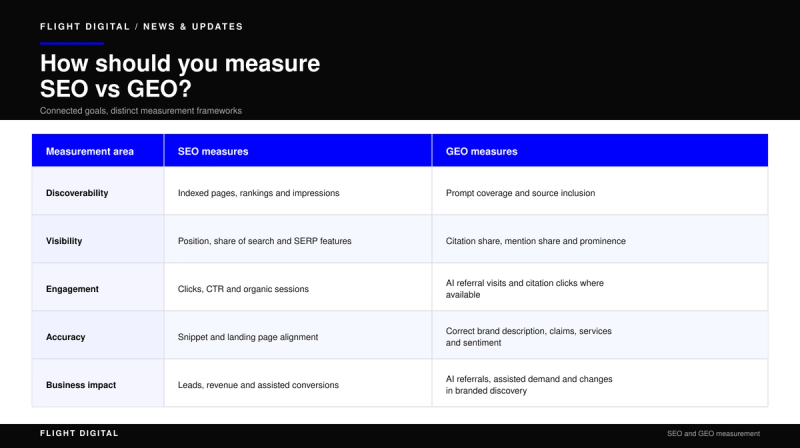
A practical measurement process can include:
- Define a fixed prompt set around priority customer questions.
- Test the same platform, location, language and account conditions where possible.
- Record mentions, citations, source URLs, accuracy and competitor presence.
- Connect referral traffic and conversions in analytics.
- Review Search Console data alongside analytics and CRM data.
- Report trends over time rather than treating one answer as a permanent result.
Google says traffic from AI Overviews and AI Mode is included in the overall Web performance data in Search Console. Search Console should therefore remain part of the measurement process, alongside analytics and commercial reporting.
Attribution will not be perfect. Personalisation, changing answers, missing referrer data and platform differences make it difficult to identify every influence. The goal is a consistent and useful measurement process, not false precision.
A 90 Day SEO and GEO Action Plan
Days 1 to 30: Establish the baseline
Review technical eligibility, priority pages, internal linking, brand consistency, current citations, referral traffic and priority search prompts.
Days 31 to 60: Improve priority content
Strengthen answer first openings, expert input, supporting evidence, page structure, internal links and conversion paths on the pages that matter most.
Days 61 to 90: Build authority and test visibility
Publish supporting content where a genuine gap exists, earn relevant external coverage, rerun the prompt set and compare visibility, accuracy, visits and conversions with the baseline.
The exact work will depend on the organisation’s size, search landscape, content maturity and commercial priorities. A smaller organisation does not necessarily need a separate GEO programme. It can begin by improving its SEO foundation, expert content and measurement process.
How Flight connects SEO, GEO and digital performance
Flight has more than 10 years of digital experience, with SEO and GEO delivered as part of a wider performance practice. Search visibility is considered alongside content, UX, analytics and platform architecture, rather than added after a website launches.
For Flight, that means:
- Making pages technically accessible, crawlable and easy to understand
- Structuring content around search intent, entities and customer questions
- Connecting internal linking and content strategy with useful user journeys
- Improving the experience after the click, not just visibility before it
- Measuring rankings, citations, referrals, leads and commercial signals together
- Maintaining and improving the platform as search behaviour changes
Flight has launched more than 40 digital platforms and supports 100 ongoing partnerships. Its work on the NST Parts headless ecommerce platform shows how structured technology, content and customer journeys need to work together. Flight also shares its perspective on SEO content velocity, including the role of original expertise, content maintenance and AI search visibility.
The aim is not to create separate SEO and GEO versions of a website. It is to build a clear, technically sound and useful digital platform that people, search engines and AI systems can understand, trust and act on.
Should Your Business Invest in GEO Now?
GEO deserves attention when customers research complex or high consideration decisions, AI answers are already visible for priority topics, brand accuracy matters or competitors are frequently cited.
It may not need to be a separate project. For many organisations, the right first step is to improve technical SEO, content quality, internal linking, expert input and measurement.
Flight Digital’s view is simple: GEO should be treated as part of modern search strategy, not as a replacement for SEO or a collection of shortcuts. The strongest digital platforms make organisations easier to find, understand and trust wherever people search.