Active Adventures - 2025 Onwards
Scaling a global travel ecosystem.
Explore

Flight Digital is a New Zealand CMS migration and replatforming agency. We help organisations move from ageing, restrictive or difficult-to-manage platforms to a digital foundation that is easier to publish, integrate and improve.
We plan and deliver CMS migrations, website migrations and digital platform replatforming. From the first content inventory to post-launch monitoring, we account for content, URLs, integrations, analytics and organic search.
If a migration is not the right answer, we will say so. An upgrade, restructure, rebuild or phased programme may be the better path.
Whether you are planning a new digital platform or moving beyond an existing CMS, we can help you understand the options, define the right architecture and turn it into a platform that works well after launch.
A CMS that worked well when your website was smaller can become a constraint as your organisation grows.
A migration may be worth exploring when:
A CMS migration is not automatically the answer. We assess whether to improve the current platform, rebuild it, migrate to a new CMS or phase the work over time.
A successful migration is more than moving pages from one system to another. It should leave your organisation with:
The right outcome depends on your current platform, content, team and business priorities.
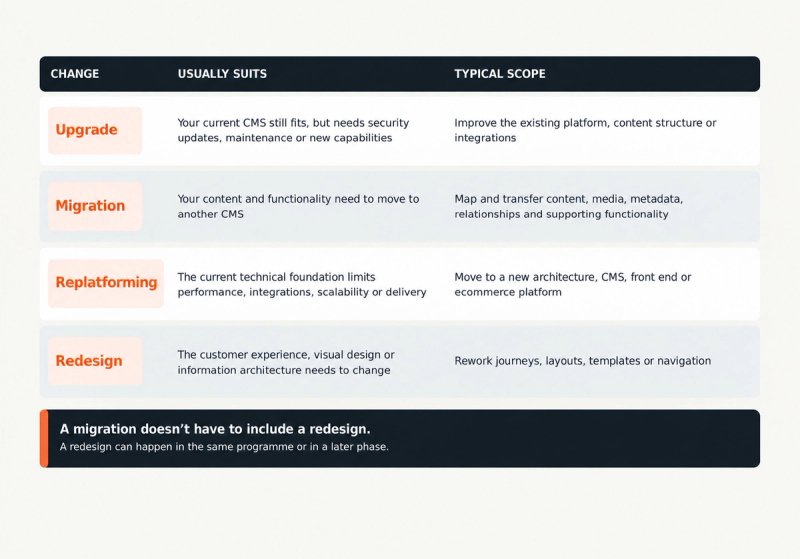
These terms describe different types of change.
Our CMS migration services are suited to:
Flight Digital is based in Auckland and works with organisations across New Zealand, Australia and the UK. The projects below show the range of migration and replatforming work we support.
Our role is to connect the decisions that are often split between strategy, content, UX, development, analytics and SEO.
We make the current platform, content and dependencies visible before recommending a solution.
The discovery can cover:
We then define the practical path: improve, migrate, replatform, redesign or phase the work.
A new CMS should make content easier to manage, find and reuse. We can help define:
This prevents the new platform from simply reproducing the structural problems of the old one.
We can configure or build the new digital platform, including:
We do not recommend a platform because it is fashionable. We start with the content, technical, commercial and operational requirements.
Related pages: Headless CMS development · Website development
We can plan and deliver the transfer of:
For larger websites, repeatable migration processes can handle volume while manual review covers exceptions, high-value pages and content that needs rewriting or restructuring.
SEO planning starts during discovery, not immediately before launch.
We can support:
Related pages: SEO services · Headless CMS and SEO checklist
Before launch, we test the parts that can create user, operational or search problems:
After launch, we monitor the agreed baselines and help your team resolve issues and prioritise improvements.
We review the CMS, content, URLs, templates, integrations, analytics, hosting, workflows and performance.
The output is a shared view of what exists, what matters, what is risky and what should change.
We agree the business goals, content requirements, technical needs, governance model and migration scope.
We compare the platform options against those requirements rather than assuming that a particular architecture is right.
We create a content inventory and decide what each item should do next:
We also define the new content model, URL map, redirect rules, metadata requirements and integration dependencies.
We build the new platform and migrate a representative sample before committing to the full transfer.
This gives the team a chance to test:
We use what we learn to refine the migration process before scaling it.
We complete content, technical SEO, redirect, analytics, integration, performance and stakeholder checks.
The launch plan reflects the risk of the project, the operating needs of your team and any requirement for staged releases or a contingency plan.
After launch, we monitor:
The post-launch data helps separate migration issues from longer-term opportunities.
A website migration can affect organic performance when important URLs, content, internal links, technical signals or user journeys change.
The aim is to make those changes deliberate, testable and measurable. No agency can guarantee rankings because search performance depends on many factors outside the migration itself.
We can establish:
We check:
We crawl and monitor the new site for:
Related page: Headless CMS and SEO checklist
There is no universal best CMS. The right choice depends on your content, team, integrations, markets, budget and long-term operating model.
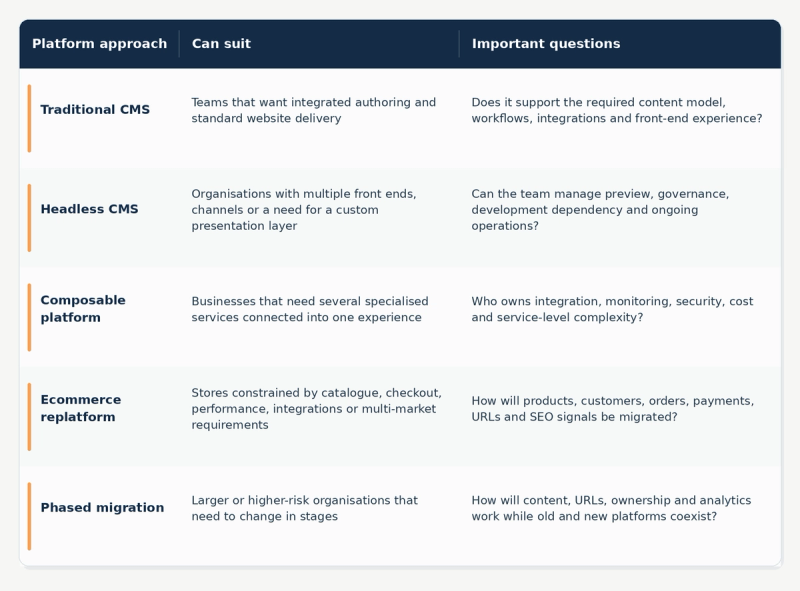
Headless is not automatically the right answer. A well-supported traditional CMS can be a better fit when integrated editing, simplicity and internal capability matter most.
If Sanity suits your requirements, explore our Sanity migration services and Sanity CMS development. For a Silverstripe-specific project, see our Silverstripe developers in New Zealand.
Flight Digital is an Auckland-based digital agency that designs, builds, migrates and grows digital platforms.
Our migration approach brings together:
The difference is how these disciplines connect. We can review URLs and organic search before development, model content before bulk migration, test a representative sample before scaling, and validate analytics and conversion journeys at launch.
We can support a phased migration programme or a larger platform change. The goal is a platform that is easier to manage, easier to improve and better aligned with how your organisation operates.
Need a clearer path from your current CMS to your next platform?
Talk to Flight Digital about your migration goals, content, technical requirements, markets and next steps. You do not need to have chosen the target platform before starting the conversation.
Talk to our customer service team
01
A CMS migration moves content, media, structures and supporting functionality from one content management system to another.
It may also include URL changes, SEO planning, analytics, integrations, templates and editorial workflows.
02
CMS migration focuses on transferring content and functionality.
Replatforming means moving to a new technical platform or architecture. It often includes a CMS migration, but may also involve a new front end, hosting model, ecommerce system or integration layer.
03
There is no reliable single price without understanding the scope.
The main factors are content volume, content complexity, number of templates, platform choice, integrations, design work, number of markets, manual migration effort, SEO requirements and internal review capacity.
A discovery phase can clarify the scope and provide a more useful estimate.
04
The timeline depends on the website, platform, content volume, integrations, markets and project scope.
A staged approach can reduce risk and allow larger organisations to manage the work alongside day-to-day operations.
05
Yes. A CMS migration can preserve the current design while changing the underlying platform.
A redesign can happen during the same programme or in a later phase.
06
We can assess migrations from Silverstripe and other content management systems. The right approach depends on the current content structure, templates, integrations, hosting, editorial workflows and future requirements.
07
We create an inventory and assess content by value, accuracy, performance, user need, duplication, ownership and future usefulness.
Each item can be marked to keep, improve, merge, redirect, remove or rebuild. This avoids carrying unnecessary content and structural problems into the new CMS.
08
Any major website change can affect organic performance.
We reduce avoidable risk through URL mapping, redirects, metadata and canonical checks, technical SEO testing, analytics validation and post-launch monitoring. Rankings cannot be guaranteed because search performance also depends on competition, content quality, technical factors and search-engine changes.
09
Not always.
A headless CMS may suit organisations that need multiple front ends, flexible content delivery or complex integrations. A traditional CMS may be better when integrated authoring, simplicity and internal capability are more important.
010
We inventory the content and media first, then map the old structure to the new one.
High-volume content can be transferred through repeatable processes. Pages that need rewriting, restructuring, relationship fixes or manual review are handled as exceptions.
11
We document the existing integrations and confirm what needs to be retained, rebuilt or replaced.
We test forms, APIs, search, analytics, CRM connections, ecommerce services and other systems before launch.
12
Yes. A phased approach can reduce risk, support business continuity and let a larger organisation address the highest-priority content or platform constraints first.
The plan must define how content, URLs, analytics, ownership and integrations work during the transition.
13
We monitor indexation, redirects, technical errors, organic performance, conversions, website performance and content workflows.
We can then prioritise fixes and support ongoing SEO, content and platform improvements.