We've spent years helping businesses build better digital experiences, and increasingly, that means helping them move beyond traditional CMS platforms. We've guided clients through migrations from WordPress and Drupal to Sanity, and the difference in what they're able to achieve afterwards is remarkable.
It's not that traditional platforms are bad. They've served the web well for a long time. But the way businesses use their websites has changed dramatically. More channels, more complexity, higher performance expectations. The tools need to keep up.
That's where headless content management comes in.
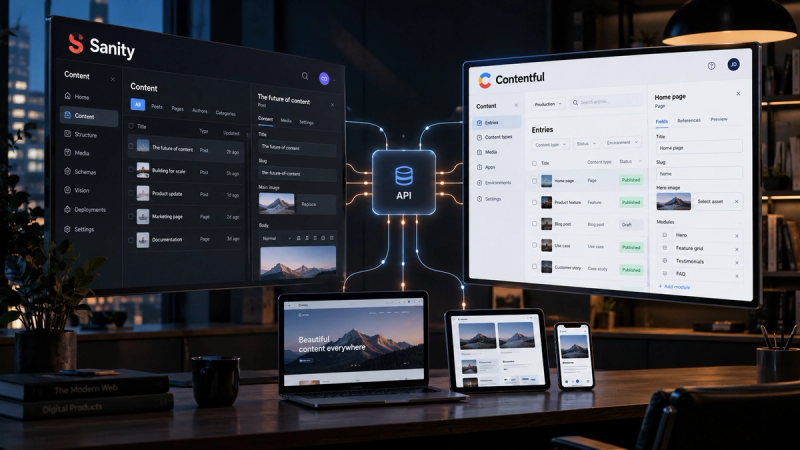
Sanity separates content management from the frontend experience, giving businesses greater control over how content is structured, managed and delivered. Traditional CMS platforms typically combine these functions within one system.
Both approaches have their place. But for businesses managing complex content, custom digital experiences or multiple channels, a headless CMS can offer greater flexibility.
Here's why we think headless, and Sanity specifically, is worth considering for businesses serious about growth.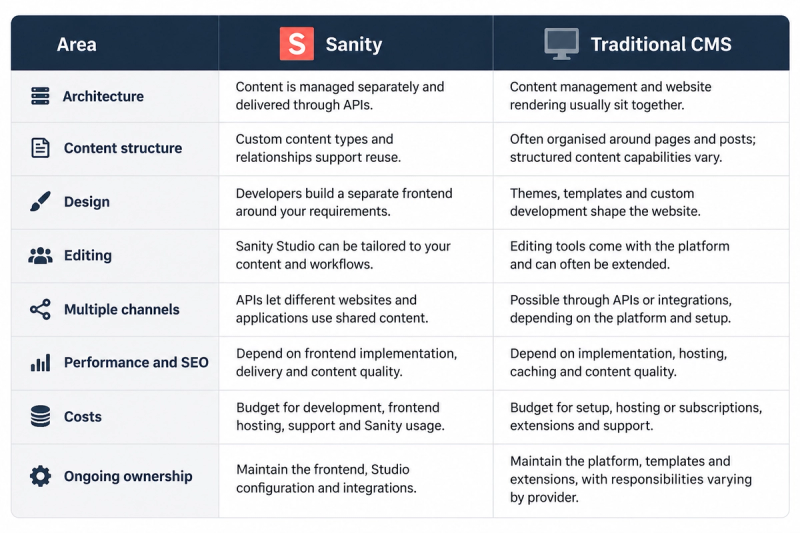
The biggest distinction is architectural. Sanity is designed around structured content delivered through APIs, while traditional CMS platforms generally offer an integrated approach to content and website management.
However, some traditional CMSs also support headless delivery, so the comparison ultimately depends on how each platform is implemented.
What is a traditional CMS?
A traditional CMS, think WordPress, Drupal or Squarespace, generally combines content management and website presentation within the same system.
Your team manages content through an admin interface, while the CMS uses themes or templates to display that content to visitors.
For years, this has been the standard approach, and it still works well for many websites.
Traditional CMS platforms offer several advantages:
- Familiar editing and publishing tools.
- Established themes, templates and extensions.
- Integrated content and website management.
- Potentially lower initial development costs for straightforward websites.
- Large communities and established support ecosystems.
The challenge comes when your business needs more flexibility than its current implementation provides.
You might want a highly customised experience, complex integrations or content that can be reused across different platforms. Depending on the CMS, those requirements can involve additional plugins, custom development or changes to the existing architecture.
What was once a convenient solution can become a constraint when the business needs to evolve.
That doesn't mean traditional CMS platforms cannot support complex websites. WordPress and Drupal both offer APIs, structured content capabilities and custom development options.
The question is whether the platform continues to support what your business needs without introducing unnecessary complexity.
What is a headless CMS, and how does Sanity work?
A headless CMS separates content management from the presentation layer.
Instead of managing content and rendering the website within one tightly connected system, content is stored separately and delivered through APIs.
This means the same content can be used across websites, mobile applications, digital displays and other connected experiences.
Developers can also choose frontend technologies based on the project's requirements, rather than relying on a particular CMS theme.
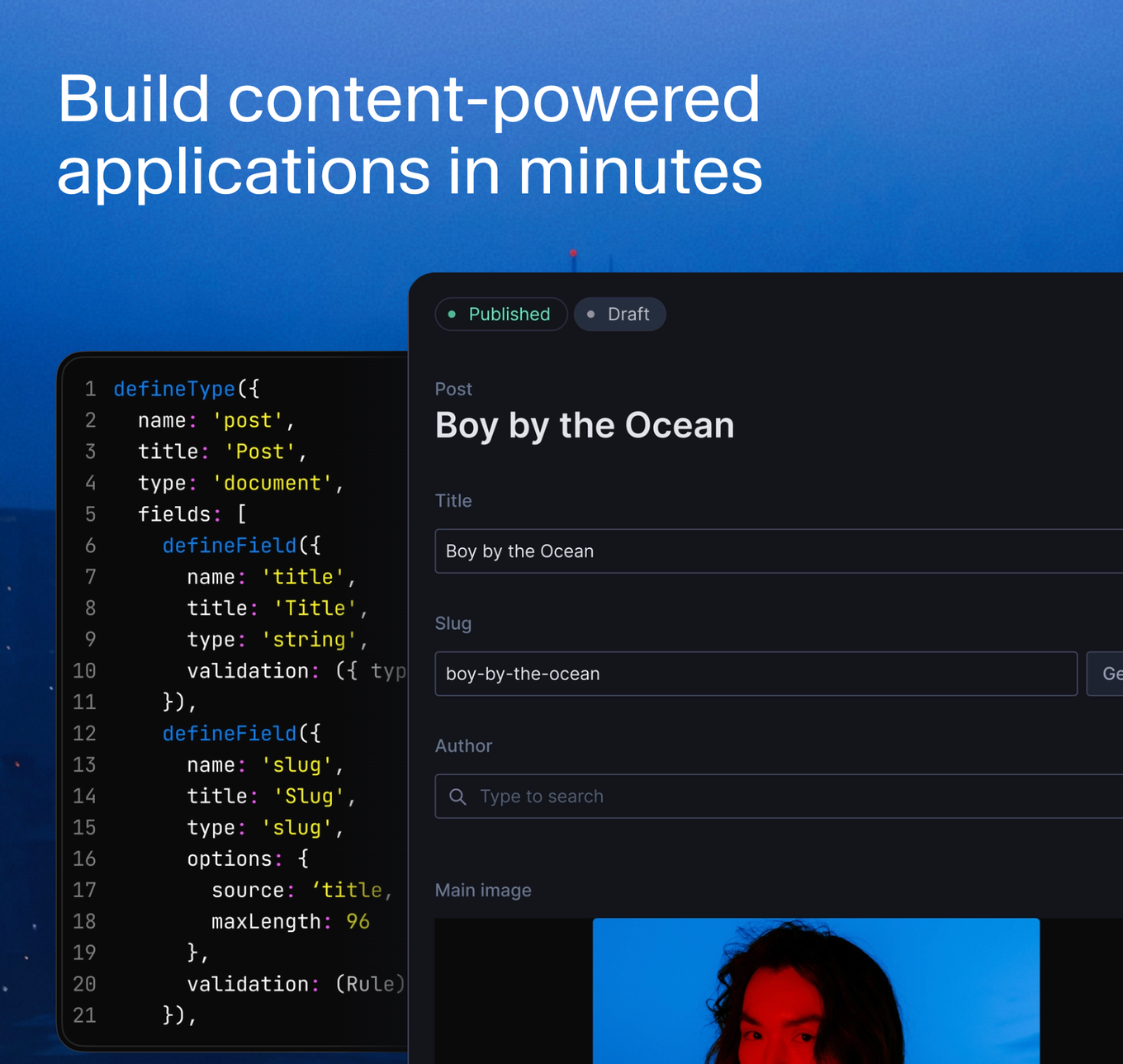
Sanity is a headless CMS and structured content platform built around this approach.
Its architecture includes three important components:
- Content Lake: A hosted system for storing and querying structured content.
- Sanity Studio: A customisable interface where teams create, edit and manage content.
- Content APIs: Services that allow websites and applications to retrieve content and use it in different experiences.
For example, a business could manage its products, locations, team profiles and services in Sanity. That content could then be displayed across multiple websites or applications without requiring separate copies for every channel.
This makes Sanity particularly useful for organisations that need to manage connected content across a growing digital ecosystem.
We've chosen Sanity as a preferred platform because it gives our developers the freedom to build custom digital experiences while making content management more useful for the teams behind them.
Our Sanity CMS development services () bring content modelling, customised editing workflows, frontend development and integrations together around each organisation's needs.
Why headless wins for growing businesses?
1. Speed and website performance
Performance is one of the reasons businesses consider moving to headless architecture.
Headless websites can be built using modern frameworks such as Next.js or Astro, giving developers control over how pages are generated, rendered and delivered.
Depending on the implementation, content can be rendered on the server, generated ahead of time or delivered dynamically.
Sanity also provides an API CDN that can serve cached content queries, reducing the need to retrieve the same information directly from its content infrastructure for every request.
This creates opportunities to optimise how a website performs.
However, headless architecture doesn't automatically guarantee faster loading times.
Large images, unnecessary JavaScript, third-party scripts and inefficient frontend implementation can still slow down a website.
Traditional CMS platforms can also achieve strong performance through caching, hosting optimisation, efficient development and content delivery networks.
What matters is the quality of the implementation.
From an SEO perspective, performance should be assessed using metrics such as:
- Largest Contentful Paint (LCP): How quickly the main content appears.
- Interaction to Next Paint (INP): How responsive the website feels when visitors interact with it.
- Cumulative Layout Shift (CLS): How stable the page remains while loading.
Google uses Core Web Vitals in its ranking systems, although strong scores alone don't guarantee higher rankings.
At Flight, we treat performance as part of the wider customer experience. A faster website should help visitors find information, navigate pages and complete important actions with less friction.
Performance isn't a nice-to-have anymore. For businesses competing online, it's a fundamental part of the experience.
2. Flexibility to build the experience your business needs
One of the biggest frustrations we hear from clients using traditional CMS platforms is that they're constantly working around limitations.
They want a custom layout, unique interaction or specific feature, only to discover that it requires another plugin, a workaround or significant changes to their existing templates.
With Sanity, the frontend is separate from the content layer.
That gives developers more freedom to build around the experience a business wants to deliver.
Whether it's a bespoke animation, complex product configurator, personalised customer journey or highly customised editorial layout, the design doesn't have to follow the conventions of a particular CMS theme.
This flexibility is especially valuable for organisations with distinctive customer experience requirements.
It can also make it easier to connect websites with other business systems, including ecommerce platforms, customer databases and marketing tools.
Of course, flexibility still requires thoughtful development. A custom frontend can introduce additional complexity, so every feature should serve a clear purpose.
Our approach to custom website development starts with the customer experience and business requirements before selecting the technologies that support them.
Your website should reflect your brand and what your customers need, not simply the limitations of the system behind it.
3. Omnichannel content delivery and content reuse
Content in Sanity isn't locked to a single page or channel.
Because information is stored as structured content, it can be delivered through APIs to different websites, applications and connected platforms.
For example, imagine a business operating across several regions.
Its website, mobile application and customer portal may all need access to the same product information, location details and supporting content.
With an appropriately designed Sanity content model, that information can be managed centrally and presented differently depending on the channel.
This reduces the need to duplicate content and can help maintain consistency across digital experiences.
Structured content is also valuable within a single website.
A team profile, service description or case study can be connected to multiple pages without repeatedly creating the same information.
For businesses with large content libraries, these relationships can make ongoing management significantly easier.
Traditional CMS platforms can also support content delivery through APIs. WordPress and Drupal, for example, provide ways to access content from external applications.
The difference comes down to how content is modelled, how easily it can be reused and how much custom development is required.
When businesses need a more connected approach, headless CMS development provides a way to manage content independently from the experiences that use it.
Omnichannel content delivery isn't only about publishing to more places. It's about creating a more flexible and manageable foundation for the channels your customers actually use.
4. A content editing experience teams actually enjoy
Sanity Studio is one of the reasons we enjoy working with the platform.
Unlike a generic CMS administration interface, Sanity Studio can be configured around the content and workflows that matter to each organisation.
We can tailor the editing environment to match how a client's team works, showing relevant fields, organising content types and creating relationships between information.
For example, a marketing team might need to manage campaign pages, case studies, SEO metadata and reusable content sections.
An ecommerce team may have different requirements involving product descriptions, collections, supporting content and integrations.
Rather than forcing both teams into the same editing experience, Sanity Studio can be configured around their workflows.
Real-time collaboration also allows multiple team members to work on content together.
With visual editing and preview features properly integrated, editors can see how their changes will appear before publishing.
This can reduce uncertainty during the review process and make it easier to identify mistakes.
Traditional CMS platforms also offer capable editing tools. For teams already familiar with WordPress or another CMS, an established workflow may be preferable.
The right editing experience ultimately depends on what the team needs to accomplish.
A good CMS should make common tasks easy:
- Creating and updating pages.
- Managing reusable content.
- Editing SEO metadata.
- Previewing changes.
- Collaborating on content.
- Managing publishing permissions.
When your team can manage content confidently, publishing becomes more consistent and the website becomes easier to maintain.
That's a competitive advantage that's easy to underestimate.
5. A platform that scales with your business
Growth brings more than additional website visitors.
It can also mean thousands of content records, more editors, multiple markets, new languages and a growing number of integrations.
We've seen traditional CMS implementations become harder to maintain as content, plugins and custom functionality accumulate.
Simple updates begin taking more time. Integrations become harder to manage. The platform that once supported the business starts slowing it down.
Sanity takes a different architectural approach.
Its hosted content infrastructure sits separately from the frontend, allowing each part to be managed and developed according to its requirements.
Sanity's APIs and CDN can support content delivery at scale, while structured content makes it easier to manage growing libraries and more complex relationships.
A good example is Flight's work with Sneaker Freaker, where we rebuilt a global media platform on Sanity to support a content library containing more than 90,000 articles.
This illustrates how a structured headless architecture can support complex publishing needs.
However, Sanity still requires appropriate configuration, content modelling, integrations and frontend infrastructure. Usage allowances and technical requirements also need to be considered.
Traditional CMS platforms can scale successfully too, provided their architecture and infrastructure support the workload.
The real advantage of headless is the ability to evolve different parts of the platform independently.
Your business can introduce new experiences, improve how content is managed and extend functionality without necessarily rebuilding the entire content system.
Is Sanity better for SEO than a traditional CMS?
One of the most common questions businesses ask when considering Sanity is whether headless architecture improves SEO.
Sanity can support excellent SEO, but the CMS alone doesn't determine how well a website ranks.
Search performance depends on content quality, crawlability, rendering, internal linking, website structure and the overall user experience.
Traditional CMS platforms often provide SEO features through built-in controls or plugins.
Sanity provides greater freedom to define those features within the content model and frontend, but they need to be deliberately implemented.
For example, a Sanity website should provide editors with controls for:
- SEO titles and meta descriptions.
- Canonical URLs and indexation settings.
- Heading structures.
- Image alternative text.
- Structured data.
- Internal linking.
- URL slugs and redirect requirements.
Rendering is particularly important.
Search engines need to access and understand the content within a page. Depending on the frontend framework, server-side rendering or pre-rendering may help make important information available in the initial HTML.
This is why we consider technical SEO during development rather than after a website launches.
Our headless CMS SEO checklist covers the foundations worth reviewing before launching a headless website.
Sanity gives developers flexibility to implement these requirements, while traditional platforms may provide some of them through existing features.
Neither approach automatically guarantees better rankings.
For businesses considering a migration, preserving existing SEO value is just as important as improving the new platform.
How does Sanity compare with WordPress?
Sanity and WordPress can both power sophisticated websites, but they take different approaches to managing content and delivering digital experiences.
WordPress is commonly used as an integrated CMS, combining content editing, themes, plugins and website delivery.
Sanity is designed around structured content and API-based delivery, with a separate frontend developed around the project's requirements.
A straightforward website with standard content and familiar publishing needs may work perfectly well on WordPress.
Sanity may be a stronger option when a business needs:
- Complex relationships between content types.
- A highly customised frontend.
- Shared content across multiple websites or applications.
- Tailored editing workflows.
- Extensive integrations with other systems.
It's also worth remembering that WordPress can operate as a headless CMS, so it isn't necessarily a choice between WordPress and headless architecture.
Both technologies can support different implementation models.
The decision should be based on the actual requirements of the project, rather than assuming one platform is universally better.
What does Sanity cost compared with a traditional CMS?
Cost is another important consideration when choosing a CMS.
A traditional CMS can be relatively affordable to implement when an organisation uses established templates and requires limited custom development.
However, costs can increase as plugins, integrations, maintenance and custom functionality are added.
Sanity has a different cost structure.
Its content platform offers free and paid plans, but businesses also need to budget for the separate frontend and associated development work.
Typical Sanity project costs may include:
- Content modelling and Studio configuration.
- Frontend design and development.
- Content migration.
- API integrations.
- Frontend hosting.
- Sanity usage and subscription requirements.
- Ongoing support and maintenance.
The right comparison is not simply the cost of a CMS subscription.
It's the total cost of building, running and improving the platform over time.
For some businesses, a traditional CMS will be the most cost-effective choice.
For others, investing in Sanity may create long-term value through reusable content, more flexible integrations and better support for evolving digital experiences.
That value needs to be weighed against the development investment and ongoing technical support required.
Is headless right for your business?
We'll be honest. Headless isn't the right choice for every situation.
If you're running a simple brochure website with a handful of pages and no plans to expand, a traditional CMS might be perfectly adequate.
The additional complexity of a headless setup isn't always justified for smaller projects.
But if your business has growth ambitions, operates across multiple channels or has content needs that go beyond a standard website setup, Sanity deserves serious consideration.
When Sanity makes sense
Sanity can be particularly valuable when your organisation:
- Manages a large or growing content library.
- Needs content to be reused across different digital experiences.
- Requires complex content relationships.
- Operates across multiple brands, languages or regions.
- Wants greater freedom over frontend design and functionality.
- Needs custom workflows for content editors.
- Has access to ongoing development support.
Sanity isn't the only headless CMS available. Platforms such as Contentful and Strapi also offer headless approaches with different features, hosting models and developer experiences.
There is no single best headless CMS for every organisation.
The right platform depends on how your content is structured, the experience you want to deliver and what your team can manage long-term.
At Flight, we look at the broader requirements before recommending a platform. Technology should support your business, not create complexity without a clear benefit.
What should businesses consider before migrating to Sanity?
Moving from a traditional CMS to Sanity is an opportunity to improve how content is structured and delivered.
But migration involves more than moving text and images into a new platform.
Businesses need to consider existing content, integrations, functionality, SEO requirements and the workflows their teams rely on.
A good migration plan starts by understanding what already exists.
Which pages and content types need to be retained? Which could be improved or consolidated? What functionality needs to be recreated?
From there, the new content model can be designed around how the business intends to manage information in the future.
SEO also needs to be included from the beginning.
Important considerations include preserving valuable URLs where practical, mapping redirects for changed URLs, migrating metadata and structured data, updating internal links and testing how content is rendered.
Analytics, forms, integrations and publishing workflows should also be tested before launch.
We've helped organisations move from legacy platforms to modern headless architectures, including projects involving Active Adventures, Sneaker Freaker and Allpress Espresso.
These projects have different requirements, but they share a common objective: building digital platforms that can support what comes next.
Our Sanity migration services bring together platform planning, content migration, frontend development and SEO considerations to help organisations make that transition.
A migration cannot guarantee unchanged search rankings or website performance. But careful planning reduces avoidable risks and creates a stronger foundation for future improvements.
Build a CMS around your business, not the other way around
The choice between Sanity and a traditional CMS comes down to how your business manages content, serves customers and plans to grow.
Traditional platforms still make sense for many websites. They can be practical, familiar and cost-effective when their capabilities match the organisation's requirements.
But for businesses that need more control over content, custom digital experiences or connected platforms, headless architecture offers meaningful advantages.
Sanity gives us the flexibility to bring those elements together without tying every experience to a single CMS frontend.
At Flight Digital, we combine strategy, design, content, development and SEO to build digital platforms that work for both businesses and the people using them.
We believe your technology should make it easier to create better digital experiences, not stand in the way.
Whether you're considering Sanity, exploring headless architecture or planning a complete website rebuild, get in touch with our team and let's talk about the right approach for your business.